

“Our API is the UI.”
That’s how Marc Benioff announced Salesforce Headless 360 at TDX. The entire Salesforce, Agentforce, and Slack platforms exposed the Agents. You don’t need a browser when you cover everything with APIs, MCP tools, and CLI commands.
60+ new MCP tools and 30+ coding skills shipped immediately, giving AI agents running on Claude, GPT-4o, Gemini, and Cursor complete programmatic access to Salesforce data directly, without any human-facing interface mediating the interaction.
API Governance Checklist
A strategic guide for software architects, platform engineers, and API leadership looking to solve or upgrade their API Governance Programme.
Download Ebook
When an entire enterprise software platform removes its UI layer and exposes itself solely as APIs for AI agents to consume, the question every API team should ask is: Who notices when something goes wrong?
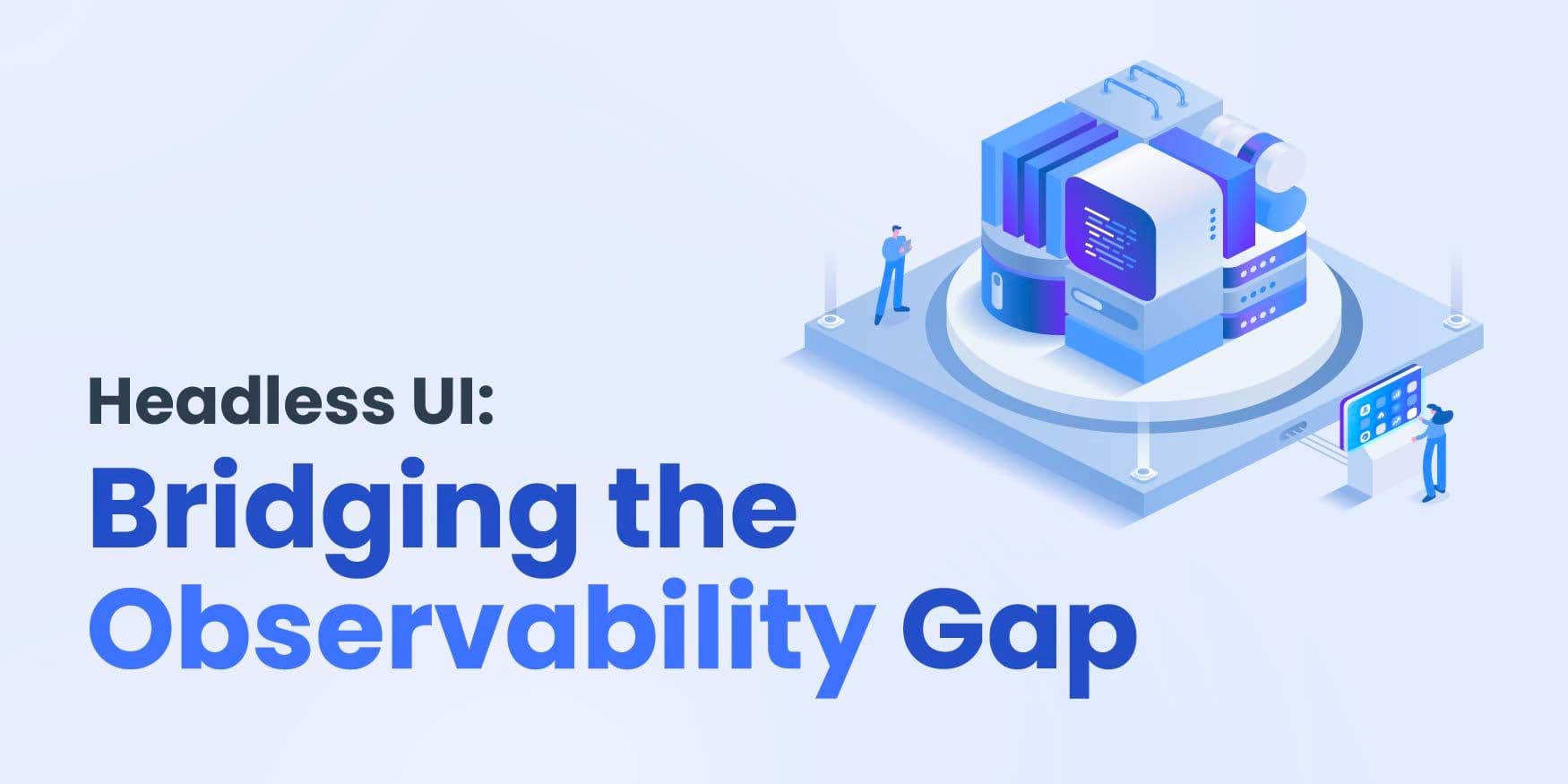
Headless API observability is the practice of monitoring APIs that are primarily consumed by machines (AI agents, automated pipelines, or service-to-service calls), where no human-facing interface exists to surface failures as user-visible errors. Without the UI layer as an intermediary, the signal that something has broken must come entirely from the API traffic itself.
In February 2026, Sam Altman said, "Every company is now an API company." Salesforce listened. At scale.
An entire platform was reorganized so that AI coding agents have complete programmatic access without touching a browser.
That has direct implications for every team running APIs, not just the ones integrating with Salesforce. If your APIs are consumed by AI agents today, you're already in the headless model, whether you've framed it that way or not.
The practical question is whether your current observability setup was designed for this. Almost certainly, it wasn't.
“Do not remove a fence until you know why it was put up in the first place.” –G.K. Chesterton
The browser was a filter and a reporter. A bad API response would lead to a broken UI (visible). Latency spikes would load pages slower, causing users to complain (rightfully). Authentication fails would lead to login screen errors.
All of these would inform the team that something’s wrong, leading to a investigation and fix.
The same applies to traditional API monitoring design. Error rate dashboards are calibrated around human feedback loops. Alerting thresholds treat sustained error spikes as signals because there's an implicit expectation that isolated failures will be caught earlier at the UX layer.
Headless removes that filter.
When AI agents are your consumers, a 500-series error that would generate twenty support tickets in a browser app might generate zero signal. The agent handles the error programmatically: retrying, falling back to a cached response, or silently returning an incomplete result to the caller. The gateway log shows the 500. No alert fires because the rate threshold isn't crossed. The failure propagates downstream.
This is the core problem. The monitoring infrastructure most teams have was designed for a consumer who complains. AI agents don't.
Fixing this doesn't mean building more dashboards. It means rethinking what data you collect per request and what questions that data needs to answer.
Gateway-level monitoring captures status codes, latency, and endpoint paths. That's enough to know a call happened and whether it succeeded at the HTTP layer. It tells you nothing about what an agent sent or what your API returned. When an agent calls your endpoint with an unexpected input pattern, or when your API returns a structurally valid but logically incorrect response, the failure is invisible at the metadata level. Payload inspection is what surfaces it.
Treblle captures the full request and response bodies for every API call, masking sensitive data at the SDK level before it ever leaves your infrastructure. The capture isn't sampled or approximated. It's 100% of traffic, 50+ data points per request. That matters because in agentic workloads, the failure you're looking for is often in a specific request, not in aggregate trends.
It’s harder than it sounds. In browser-based apps, "who is calling this endpoint" is answered by user authentication: you know the user ID. In headless environments, the consumer is often an AI agent acting on behalf of a user, sometimes across multiple service boundaries. Knowing that a request came from "authenticated user 4821" doesn't tell you which agent invoked the call, with what prompt context, or as part of which workflow chain.
Consumer Intelligence in Treblle goes beyond authentication metadata to surface who your API consumers are at every stage: from initial discovery to active integration, usage patterns, and behavioral signals. Combined with HTTP Client Detection (which identifies specific agent clients and their exact versions) and Consumer Fingerprinting, you get enough context to distinguish expected agent traffic from anomalous patterns. When a new agent starts hitting endpoints at 10 times the normal rate, the fingerprinting layer detects the behavioral shift before it reaches the threshold breach.
AI agents operate at machine speed. A misconfigured agent can exhaust API rate limits, trigger compliance violations, or generate thousands of malformed requests in the time it takes a human to notice something is wrong and open a dashboard. Observability data that arrives in five-minute batches gives you a historical record of the failure rather than the ability to catch it as it develops. Treblle ingests every captured request the moment it happens, with no processing lag between the request and the data being queryable.
Traffic spikes, compliance checks, governance scores, and performance metrics. In a headless environment, no single dimension tells the full story. An agent making a large volume of calls might be legitimate (a batch sync job) or anomalous (a runaway loop). The difference shows up in the combination of signals: call volume alongside unusual endpoint distributions, payload patterns, and compliance flags.
Treblle's Composite API Heartbeat distills every available signal for a given API (traffic, errors, compliance, governance, performance) into a single continuous health indicator. It's the instrument that replaces the UI layer's implicit canary function. When the heartbeat degrades, something has changed in how the API is being used, regardless of whether any individual metric has crossed a threshold.
API Governance Checklist
A strategic guide for software architects, platform engineers, and API leadership looking to solve or upgrade their API Governance Programme.
Download EbookMost observability systems are built for reactive workflows: something goes wrong, an alert fires, and someone investigates. That model has acceptable latency when humans are the consumers. A user complains, a ticket opens, and the team has time to diagnose and fix before the problem compounds.
When AI agents are the consumers, the failure mode compounds before you've opened the ticket. An agent invoking a degraded endpoint doesn't wait; it continues making calls, potentially caching bad responses or passing corrupted data to downstream systems. By the time an alert fires and someone looks at the dashboard, the blast radius has already expanded.
Treblle's Predictive Risk Detection identifies APIs that are trending toward failure, non-compliance, or performance degradation before they reach the threshold that triggers an alert. The system uses historical patterns across Treblle's analysis of over one billion API requests per month to distinguish normal variation from the early trajectory of a real problem. For headless API environments specifically, that distinction is the difference between a managed incident and a cleanup operation.
Treblle compares live API traffic against your uploaded OpenAPI Specification in real time and flags divergences: undocumented endpoints, parameters that behave differently than the spec describes, and response schemas that don't match what's documented.
In a browser app, a drifted spec is a developer friction problem. In a headless environment, it's an agent reliability problem. AI agents consuming your API via MCP tools depend on the spec being accurate. When the spec drifts from production behavior, the agent operates on incorrect assumptions. The result is a silent logical failure, not an HTTP error. Spec drift detection sits at the intersection of observability and documentation, and it's one of the places where governance tooling directly reduces operational risk in headless deployments.
What is headless API observability?
Why does headless architecture make API monitoring harder?
What's the difference between API monitoring and API observability?
How many data points should an API observability tool capture per request?
Can existing API gateways handle headless observability?

All Systems Operational

Gartner: Magic Quadrant, 2025
Gartner AI API Strategy, 2025

Everest Group: Enterprise App Integration Platforms, 2026