
api-governance
API Management vs API Governance: What's the Difference

Summarize with


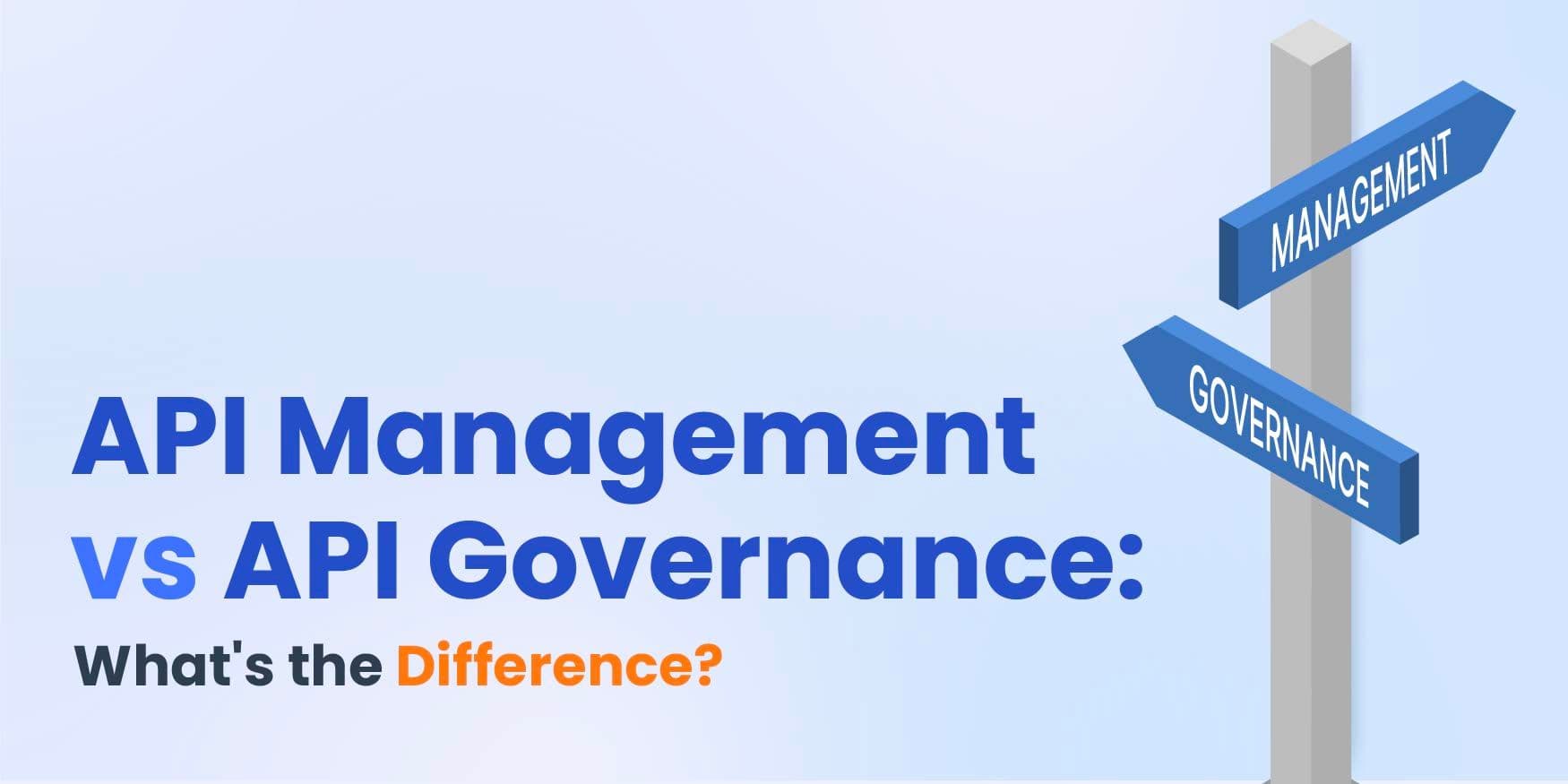
API management and API governance are often described as interchangeable or as subsets of each other, but that’s far from the truth.
API management covers the operational layer: how your APIs run. API governance covers the standards layer: how your APIs are built, what quality they meet, and whether those standards hold over time. The two work together, but conflating them leads to investing in the wrong one first.
A useful test: if 47% of your APIs are processing requests without any authentication, is that a management problem or a governance problem?
The authentication problem falls under API management. But the reason authentication isn't enforced on 47% of APIs is that no governance standard required it, no enforcement mechanism verified it, and no runtime monitoring caught the gap. The problem exists at the governance layer.
API Governance Checklist
A strategic guide for software architects, platform engineers, and API leadership looking to solve or upgrade their API Governance Programme.
Download Ebook
API management is the operational infrastructure that controls how traffic flows to and through your APIs. The core capabilities are routing and load balancing, rate limiting and throttling, authentication enforcement at the gateway, caching, and developer portal tooling for API consumers.
API management answers the question: are my APIs running correctly right now? It operates at the traffic boundary and enforces the policies you have configured. It has no opinion on whether those policies are comprehensive, whether the APIs themselves are well-designed, or whether production behavior matches the specification.
A gateway like Kong, AWS API Gateway, Apigee, or Azure API Management is an API management tool. They’re useful and necessary, but limited in scope. They don’t tell you about the unregistered APIs, score your endpoints against a quality standard, detect when your documentation has drifted from actual behavior, or flag that an endpoint hasn't been touched in six months and probably should be decommissioned.
API governance is the set of policies, standards, and enforcement mechanisms that control how APIs are designed, built, deployed, and retired across an organisation. It starts from an OpenAPI specification and lasts until deprecation, ensuring every API meets consistent standards for security, quality, and compliance, regardless which team built it.
Two things matter here. First, governance applies to the program, not individual APIs. You cannot govern your APIs well if each team defines "good" differently. Second, governance must cover the full lifecycle, including retirement.
Effective governance means monitoring both design time and runtime APIs to ensure they meet the standards. Most governance programs run into trouble because they have no visibility into production APIs.
Our Anatomy of an API Report 2025 indicates why production matters. There are simply too many discrepancies between design time and runtime:
42% of all API traffic runs over unencrypted HTTP,
46% of APIs have no versioning strategy, and
17% of tracked endpoints are zombie APIs that are live and accessible but no longer actively maintained.
The global API Scorecard sits at 58/100 in 2025, a failing grade.
Our What is API Governance pillar article dives deep into this topic.
Some capabilities sit at the intersection of both disciplines, which is part of why the terms get conflated.
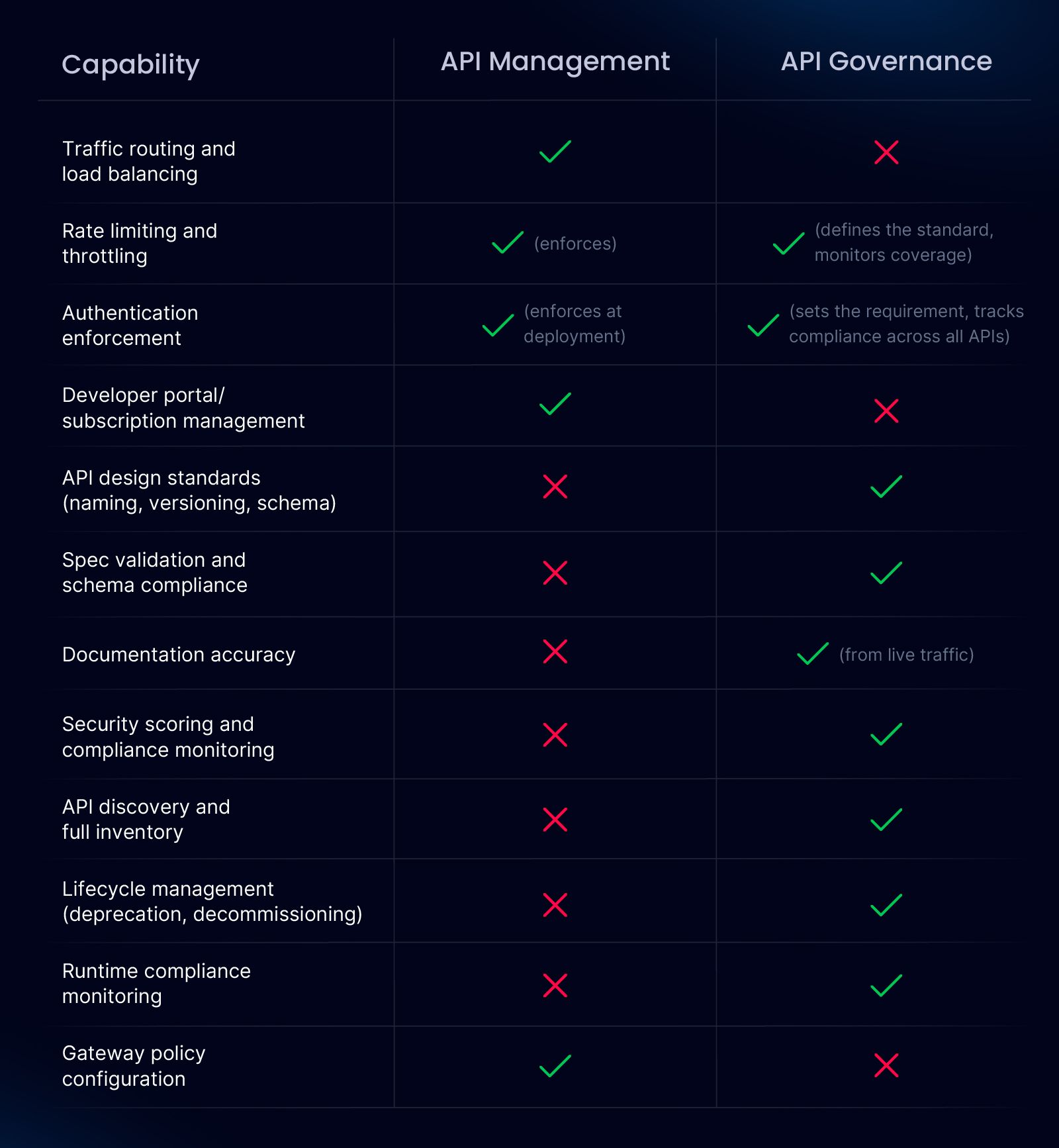
Authentication is the clearest example of the overlap.
A gateway enforces authentication for:
the traffic it handles,
the APIs registered with it,
using the policy you've configured.
API governance defines:
what authentication is required,
what mechanisms are acceptable,
which endpoints are exempt, and why, and
monitors whether that requirement is actually met across the full API surface, including internal microservices that don't route through the gateway.
Rate limiting works the same way. The management layer implements rate limits on configured routes. The governance layer defines the standard (all public APIs must implement rate limiting), tracks whether the standard is met, and surfaces the APIs that aren't compliant.
Both layers fail here because only 15% of APIs are implementing rate limiting in production. The sequence is that governance failure (no standard, no compliance) allowed the management failure (no policy) to persist undetected.
API Governance Checklist
A strategic guide for software architects, platform engineers, and API leadership looking to solve or upgrade their API Governance Programme.
Download EbookNeither discipline replaces the other. A well-governed API surface without management infrastructure has no control plane, while a well-managed API surface without governance has no standards.
What to fix first?
You need management first because it’s table stakes for operating APIs. Governance without management (something to enforce against) is just documentation.
Most teams invest in management but completely miss the governance layer.
Gateways alone won’t fix authentication gaps, unencrypted traffic, and zombie endpoints. You need governance for that.
The governance layer works by enabling visibility and discovery first, plugging security gaps second, and creating standardization third.
Treblle addresses the governance layer specifically. We provide runtime monitoring, compliance scoring, documentation accuracy, and lifecycle visibility that API management tools don't provide.
It instruments at the application layer (via 30+ SDKs), which means it sees traffic that bypasses gateway-level controls, captures 50+ data points per request, and scores each API against governance standards for Security, Design, Performance, and AI Readiness.
The relationship to management tooling is complementary. Adding Treblle alongside an existing Kong or Apigee deployment doesn't replace the gateway, it closes the visibility gap that the gateway can't address. The gateway enforces the policies you've configured. Treblle tells you which APIs fall outside those policies, where the documentation has drifted, and which endpoints haven't served legitimate traffic in months.
API Governance Checklist
A strategic guide for software architects, platform engineers, and API leadership looking to solve or upgrade their API Governance Programme.
Download EbookWhat is the difference between API management and API governance?
Is API governance part of API management?
Why do so many APIs fail governance standards even when an API gateway is in place?
Which should I invest in first: API management or API governance?

All Systems Operational

Gartner: Magic Quadrant, 2025
Gartner AI API Strategy, 2025

Everest Group: Enterprise App Integration Platforms, 2026


