
api-governance
API Governance: The Complete Enterprise Guide (2026)

Summarize with


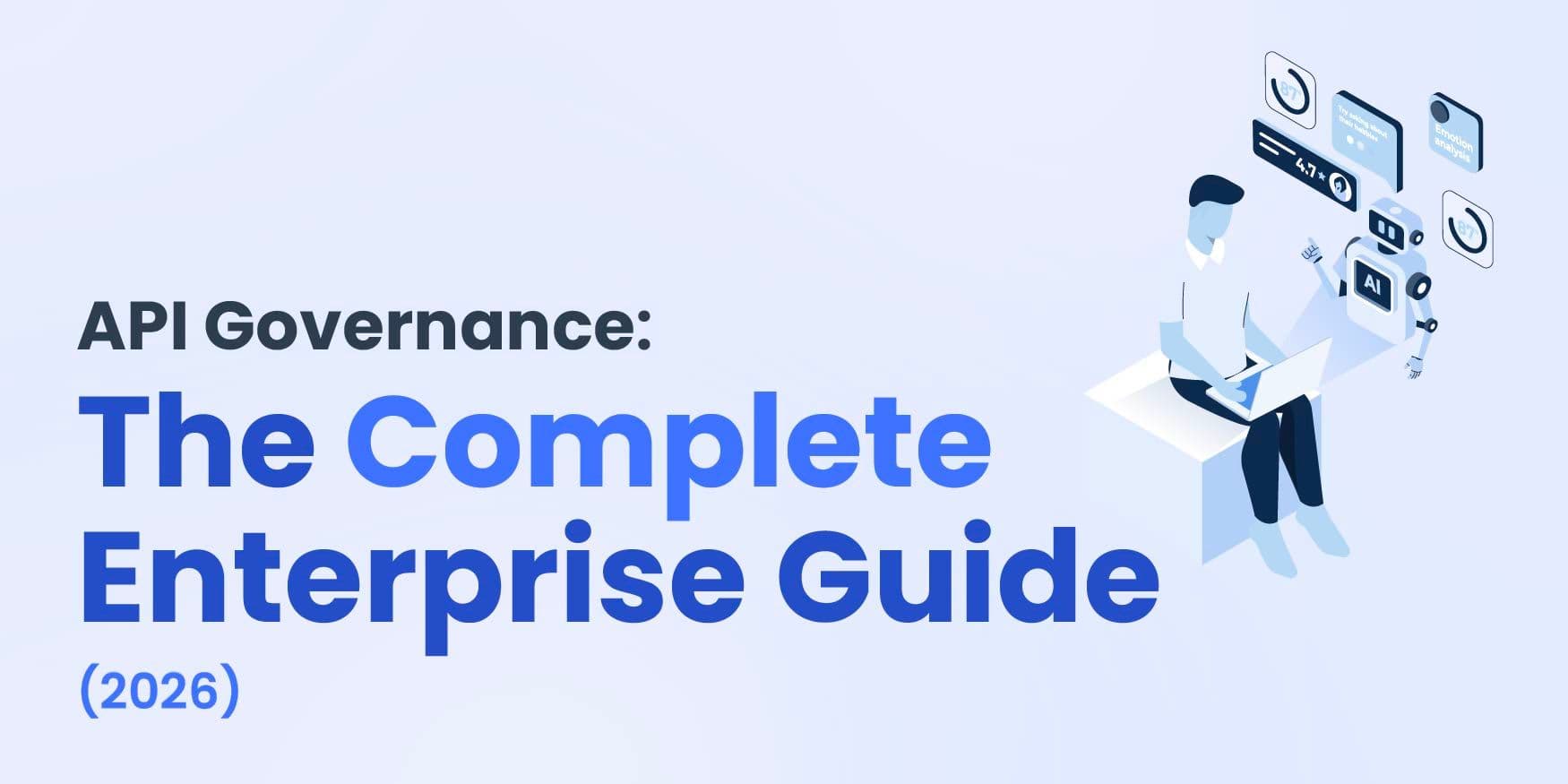
A billion real API requests showed us that the average enterprise API program scores 58 out of 100. A failing grade.
True, the average API load time dropped by 54% over the past year. You get that by investing heavily in speed. APIs are faster, but they’re no safer (or more consistent).
You don’t need more speed; you need (better) governance.
This guide covers what API governance is, why it's failing at scale, the five core pillars of a working framework, and a 90-day roadmap to get started. Everything you need, grounded in real request data, not armchair philosophy.
API Governance Checklist
A strategic guide for software architects, platform engineers, and API leadership looking to solve or upgrade their API Governance Programme.
Download Ebook
API governance is the set of policies, standards, and enforcement mechanisms that control how APIs are designed, built, deployed, and retired across an organisation. It starts from an OpenAPI specification and lasts until deprecation, ensuring every API meets consistent standards for security, quality, and compliance, regardless which team built it.
Two things matter here. First, governance applies to the program, not individual APIs. You cannot govern your APIs well if each team defines "good" differently. Second, governance must cover the full lifecycle, including retirement.
Ungoverned APIs get built insecurely, stay deployed indefinitely, and quietly accumulate as attack surface. That results in breaches, like the ones we reported on Moltbook or McKinsey.
Treblle's billion API requests analysis reveals the specific failure points:
47% of APIs process every request with no authentication. 1 in 2 API calls are anonymous.
42% of all API traffic remains unencrypted HTTP, despite Zero Trust mandates and GDPR requirements.
46% of APIs have no versioning strategy, meaning nearly half cannot evolve without risking production breakage
17% of all tracked endpoints are zombie APIs, meaning they’re live and accessible, but receive no legitimate traffic.
API Governance Checklist
A strategic guide for software architects, platform engineers, and API leadership looking to solve or upgrade their API Governance Programme.
Download EbookThese numbers are from organizations that have governance policies. However, they’re not implemented at scale. The gap between the designed and intended specification, and the runtime data is where things break down. This is where API governance fails enterprises– at scale!
APIContext research confirms this pattern. They found that 75% of production APIs don’t match their OpenAPI Specifications. When documentation no longer reflects reality, security and compliance stop being meaningful and become empty platitudes.
A working governance framework rests on five controls. The current industry failure rates across each one clearly show where you should focus first.
Every non-public API endpoint must require authentication — and 47% currently do not. Each unauthenticated endpoint is a potential entry point for lateral movement, credential stuffing, or data exfiltration. Proper governance means treating authentication as non-negotiable. OAuth 2.0, JWT, and API keys all work; enforce them automatically.
42% of traffic is still unencrypted. Most enterprises think that traffic behind the perimeter API gateway is safe. That there’s no reason to encrypt it. But that’s "perimeter defence fallacy.” Nobody is safe in an era of lateral, east-west movement attacks and AI-driven threat actors.
HTTPS is a baseline control and all API traffic should run through it.
46% of enterprise APIs have no versioning strategy, meaning every change is a potential production incident for every consumer. Usually, companies choose between stasis (never-changing APIs) and breakage (changing APIs without a compatibility plan). It’s choosing between two evils. However, there’s a third way.
A governed versioning policy defines the method (URL path /v1/ is the most practical for enterprises), the deprecation timeline, and the consumer communication process.
APIs with 100 or more endpoints grew from 4% to 38% of the market in a single year. This was driven by teams adding granular endpoints for AI agents without retiring old ones. The result: a 17% zombie endpoint rate, with Gartner data showing those endpoints account for 38% of API security breaches.
Zombie endpoints are unmaintained, outdated, and frequently exposed to threats their creators forgot about. Governance must include formal deprecation policies and automated zombie endpoint detection.
For a comprehensive playbook on detecting and eliminating zombie APIs, see the guide to zombie API detection and remediation.
The difference between well-governed organizations and those that struggle is in the cadence of applying the regulatory frameworks. Leave a ship too long off course and it will drift far away. But correct it often by a little, and you’ll never miss your mark.
Those that struggle see OWASP API Security Top 10, GDPR, PCI-DSS, and HIPAA as a one-and-done thing, only to be revisited during audit time. Well-governed organizations map each compliance requirement to a specific API control and verify it continuously at runtime.
API Governance Checklist
A strategic guide for software architects, platform engineers, and API leadership looking to solve or upgrade their API Governance Programme.
Download EbookAPI governance for design time and runtime are two sides of the same coin.
Design-time governance catches issues before deployment: linting against a style guide, validating OpenAPI Specification schemas, and running security checks in CI/CD pipelines. API Governance tools like Spectral handle this layer well. But design-time governance is fundamentally a plan and no plan survives first contact with the enemy.
In planning, developers report that they’re using versioning, but 46% of live traffic is unversioned. In planning, architects design APIs for HTTPS, but 42% of traffic flows over HTTP.
The divergence between design intent and runtime reality is a gap that top API observability tools can close. You need to see to notice the changes from the plan. Runtime governance does that for you. By capturing intelligence on every API request in production, you reveal:
Which APIs are receiving active traffic and which are zombie endpoints
Whether authentication is actually being enforced, not just defined in documentation
Whether HTTPS is in use end-to-end, including internal microservice traffic
The true error rate (13% instead of 3%): 10% of requests return HTTP 200 OK with errors buried in the response body.
Treblle's approach captures 50+ data points for every API request in real time, without sampling. Security posture, compliance status, performance, authentication behaviour–we cover all of it. This is the difference between planning for governance and being able to implement it in realtime.
API Governance Checklist
A strategic guide for software architects, platform engineers, and API leadership looking to solve or upgrade their API Governance Programme.
Download EbookA governance framework that lives only in documentation will not close the 58/100 gap. Here is a five-step process that will move the needle.
Step 1: Establish your baseline with runtime data. You can’t govern what you can’t see. Deploy an API Intelligence platform to get a real-time inventory of every endpoint in your environment. Expect your baseline to look close to the industry averages: roughly half unauthenticated, 42% unencrypted, and 17% zombie endpoints.
Step 2: Choose one of three governance models.
Centralized governance: One team owns all standards and enforcement. This works well for smaller API programs.
Federated governance: Each business unit applies central standards locally, with a CoE coordinating. You can often find this in Fortune 500 environments which have distributed engineering teams.
Hybrid governance model. Central policy definition, federated enforcement. Most large enterprises land here.
Step 3: Define specific, verifiable policies. Policies must be precise enough to test. "APIs should be secure" is not a policy. "All non-public endpoints must implement OAuth 2.0 or JWT authentication, enforced at the gateway, with a 401 response for unauthenticated requests" is. Document policies for each of the five pillars above, with a named owner per policy.
Step 4: Build the enforcement layer. Automate at two points: design-time (Spectral linting in CI/CD pipelines, blocking non-compliant merges) and runtime (automated scoring and alerting on every production request). Manual governance reviews cannot scale to modern deployment frequencies. Automation is the only viable strategy.
Step 5: Measure, score, and iterate. Governance without measurement is aspiration. Track an API quality score across security, design, performance, and compliance. The industry average is 58/100. Every point gained represents fewer vulnerabilities, lower compliance risk, and more consistent developer experience. Review scores quarterly and tie improvement targets to the engineering team's objectives.
For a deeper walkthrough with step-by-step execution guidance, see how to build an API governance framework that actually scales.
API Governance Checklist
A strategic guide for software architects, platform engineers, and API leadership looking to solve or upgrade their API Governance Programme.
Download EbookGovernance frameworks only work when they can see what is actually happening in production. That’s exactly what Treblle provides.
Treblle is an API Runtime Intelligence platform that captures 50+ data points on every single API request in real time: authentication status, encryption in use, response codes, error signatures, latency, payload structure, and compliance signals. Unlike sampling-based approaches, Treblle processes every request, giving governance teams a complete, unfiltered view of API behavior across the entire ecosystem.
This matters because the five pillars mentioned above require runtime data to enforce. You cannot verify authentication compliance from design-time documentation. You cannot detect zombie endpoints from a static inventory. You cannot measure your true error rate from HTTP status codes alone.
Treblle's runtime layer addresses each governance pillar directly:
Authentication enforcement: Treblle flags every unauthenticated request in real time, identifying which endpoints are processing traffic without identity verification.
Encryption compliance: Every request is scored for transport security. Unencrypted HTTP traffic is surfaced immediately, with endpoint-level drill-down.
Endpoint lifecycle: Treblle's API Discovery automatically catalogues every active endpoint, including shadow APIs that have never been formally documented. Zero-traffic endpoints, which are zombie candidates, are flagged automatically.
Governance scoring: Treblle calculates a real-time API quality score across security, design, performance, and compliance dimensions. The global average in 2025 is 58/100. Your score tells you exactly how far you are from that baseline, and where to close the gap first.
Callout: Treblle's average setup time is under 2 minutes. The first governance insights — authenticated vs. unauthenticated traffic, HTTP vs. HTTPS split, active vs. zombie endpoint count — are typically available within hours of deployment.
Governance tooling has to justify its cost. Treblle achieved a 247% ROI in independent analysis, driven primarily by reduction in incident response time and security remediation costs. Real-time API insights can reduce troubleshooting time by 80%, a direct consequence of replacing periodic audits with continuous observability.
For enterprise teams starting the APi governance framework mentioned above, Treblle is the instrument that makes Phase 1 (visibility) achievable in days rather than quarters. It’s also what makes Phase 5 (measure, score, iterate) repeatable, because governance without continuous measurement is aspiration, not enforcement.
Learn more about Treblle's governance capabilities in the API Governance product overview, or download the Buyer's Guide to API Observability ebook for a full breakdown of what to evaluate when choosing a runtime intelligence platform.
API Governance Checklist
A strategic guide for software architects, platform engineers, and API leadership looking to solve or upgrade their API Governance Programme.
Download EbookOne of the most actionable insights from Treblle's 2025 research: the framework you build an API on directly sets your governance starting point — before a single policy is written.
Treblle's analysis of governance scores by SDK shows a 34-point spread across commonly used frameworks:
| Framework | Governance Score |
|---|---|
| NestJS | 83/100 |
| Spring Boot | 73/100 |
| Laravel | 65/100 |
| .NET Core | 63/100 |
| NodeJS | 54/100 |
| Django | 49/100 |
Source: Treblle, Anatomy of an API 2025
NestJS's opinionated architecture enforces security defaults at the framework level. A developer has to actively work around them to produce an insecure API. Django's flexibility does the opposite: every security decision is configurable, which means every security decision can be misconfigured.
For CIOs and enterprise architects, technology selection is a governance decision. Choosing a flexible, unopinionated framework means investing significantly more in security tooling, Spectral rules, and training to reach the same baseline that NestJS provides by default. The governance cost compounds over time.
Based on the quarterly execution framework from the Anatomy of an API 2025 report:
Q1 — Visibility and Discovery: Deploy runtime API observability. The objective is 100% inventory visibility — every API, every endpoint, including shadow APIs and internal microservices that have never been catalogued. You cannot close the governance gap on assets you do not know exist.
Q2 — Close the Security Gap: Gate all APIs currently processing requests without authentication. Enforce HTTPS across internal east-west traffic. Decommission identified zombie endpoints. By end of Q2, the transport and identity layers should have no known vulnerabilities.
Q3 — Governance and Design Standardisation: Implement API style guides. Deploy Spectral linting in CI/CD pipelines. Establish design-time governance gates to block non-compliant APIs before they reach production. The goal shifts from remediation to prevention.
Q4 — AI Readiness and Expansion: Expose certified, governed APIs to AI agents via Model Context Protocol (MCP). Identify internal APIs with monetisation potential. The goal for this quarter is to transform the API program from a cost centre into a revenue-generating asset.
Download the API Governance Checklist for the full operational checklist mapped to each phase.
API Governance Checklist
A strategic guide for software architects, platform engineers, and API leadership looking to solve or upgrade their API Governance Programme.
Download EbookWhat is the difference between API governance and API management?
Why do organisations have governance policies but still score poorly?
How long does it take to implement API governance?
What is an API governance score?

All Systems Operational

Gartner: Magic Quadrant, 2025
Gartner AI API Strategy, 2025

Everest Group: Enterprise App Integration Platforms, 2026


