
api-governance
API Catalog: What It Is, Why You Need One, and How to Build It

Summarize with



After several years of API development, most organizations face the same problem: nobody knows exactly how many APIs exist, what they do, or which ones are still actively maintained. The number is usually higher than anyone expects.
The documentation is usually less current than anyone admits. The gap between what the platform team knows and what is actually running in production creates security risks, integration failures, and redundant builds.
An API catalog is the organizational answer to that problem. It is a maintained registry of every API your organization builds, including what it does, who owns it, how to access it, and whether it is still active. A catalog doesn't solve the discovery problem automatically, but it provides a single place to find the answer to a simple question: "Does an API for X already exist?"
An API catalog is a structured inventory of APIs, each described with enough detail for teams that didn't build it to evaluate and use it. The goal is discoverability and governance: if a developer needs an API for a specific capability, the catalog should tell them whether one exists, whether it's appropriate for their use case, who to contact, and how to get access.
An API catalog is not a documentation site . Documentation explains how to use a specific API in depth: endpoint references, authentication guides, and code samples. A catalog is a directory: it points to the documentation and provides the metadata needed to determine whether an API is worth using.
An API catalog is not an API gateway . A gateway handles runtime traffic management: routing, authentication enforcement, and rate limiting. A catalog is a metadata layer, not an infrastructure component. The gateway routes traffic. The catalog tells teams which APIs are available.
An API catalog is not a one-time deliverable . The moment a catalog is created, it begins to go stale. APIs get added, deprecated, changed, and abandoned. A catalog that isn't updated actively is worse than no catalog, because it misleads teams about what actually exists. The maintenance model is as important as the initial content.
An API catalog is organizational memory for your API surface . Without it, teams repeatedly rediscover the same APIs, build redundant capabilities, and overlook APIs that nobody is tracking. With it, the entire API portfolio becomes discoverable, governed, and auditable.
A catalog entry is a structured record for a single API. The content needs to be specific enough to be useful and simple enough to maintain over time. Entries that require extensive manual updates get abandoned.
Core identity fields:
API name and version. A human-readable identifier and the current production version.
Owner. The team or individual responsible for maintaining the API.
Status. Active, deprecated, or sunset, including the date the status was last reviewed.
Description. A plain-language summary of what the API does and the use cases it serves. Two or three sentences should provide enough information to evaluate the API without reading the full documentation.
Category or domain. The business domain the API belongs to, such as payments, identity, or logistics. This classification makes the catalog easier to browse.
Access and integration fields:
Base URL. The production endpoint.
Authentication method. The auth mechanism required (API key, OAuth 2.0, mTLS, etc.).
Environment availability. Whether the API is available in development, staging, and production environments, and whether there are access restrictions per environment.
Documentation link. The canonical link to the full API documentation or OpenAPI specification.
Governance fields:
SLA. Uptime and latency commitments for the API.
Deprecation timeline. For deprecated APIs, include the migration path and the date after which the API will stop responding.
Compliance tags. Any regulatory or data handling classifications relevant to the API (PII handling, HIPAA, GDPR, etc.).
Changelog. A record of breaking changes with dates and versions.
API Governance Checklist
A strategic guide for software architects, platform engineers, and API leadership looking to solve or upgrade their API Governance Programme.
Download Ebook
Each field should contain only as much detail as teams can realistically maintain. A 40-field catalog that teams abandon after six months is less useful than a 10-field catalog that stays accurate.
The hardest part of operating an API catalog isn't creating the initial entries: it's keeping them accurate as the API portfolio evolves.
Common sources of catalog drift include:
Over time, catalog drift makes it progressively less trustworthy.
The discovery problem has three components:
Finding new APIs. APIs deployed to production that haven't been registered in the catalog. This is most common in organizations where multiple teams deploy independently and the deployment pipeline does not enforce catalog registration. The catalog misses APIs because no one adds them. Without intervention, this creates shadow API risk: APIs that run in production but remain outside governance.
Detecting changes. APIs that have changed since their catalog entry was last updated. When an API adds a new endpoint, changes its authentication method, or modifies its response schema without updating the catalog entry, consumers work from stale information. Undetected changes can also create compliance gaps when catalog entries include security posture data such as authentication coverage and compliance tags.
Identifying inactive APIs. APIs that are no longer being called but remain in the catalog as active. These ghost entries add maintenance overhead and can mislead teams into depending on APIs that are no longer supported.
An API catalog stays accurate only when it connects to sources of ground truth about what's actually running instead of relying solely on manual registration. Treblle's API Discovery (Multi-Source) finds APIs across code repositories, API gateways, and live traffic. It surfaces APIs running in production regardless of whether they've been manually registered and flags catalog entries where the documentation no longer matches production behavior.
Code scanning, gateway inspection, and traffic analysis each contribute different parts of the discovery picture. For a detailed explanation of how they work together, see the API Discovery Infrastructure Guide.
These three components are often conflated in conversations about API infrastructure. They serve different functions and are not substitutes for each other.
| Component | Purpose | Does | Doesn't |
|---|---|---|---|
| API Gateway | Runtime traffic | Route requests | Discover APIs |
| API Catalog | Metadata | Describe APIs | Process traffic |
| Developer Portal | Consumer interface | Present APIs | Store metadata |
API gateway. A runtime infrastructure component that sits in the request path. It handles traffic routing, authentication enforcement, rate limiting, and request/response transformation. The gateway doesn't store metadata about APIs; it processes traffic. You configure a gateway to handle specific APIs; you don't use a gateway to find out what APIs exist.
API catalog. A metadata registry. It stores structured information about APIs: what they are, who owns them, what their status is, and how to access them. The catalog doesn't process traffic; it provides organizational visibility. You use the catalog to discover what APIs exist and evaluate whether they meet your needs before configuring integrations.
Developer portal. A consumer-facing interface that surfaces API documentation, authentication guides, SDKs, and sometimes self-service access provisioning. The developer portal is the primary interface for internal and external API consumers. A portal often draws from catalog data to display available APIs and link to their documentation. IIt adds the user interface that makes catalog data accessible to API consumers.
Each component has a distinct role: the catalog is the system of record, the gateway enforces runtime rules, and the portal surfaces the catalog to consumers. An organization can have a gateway without a catalog. Many do, which is why shadow APIs exist. An organization can have a portal without a catalog. In that case, the portal surfaces only manually registered APIs and misses any APIs that haven't been discovered. The catalog provides the foundation for consistent governance across the portal and gateway.
Treblle's Developer Portal surfaces the API catalog to internal and external consumers. It combines the discoverability of a catalog with the documentation and access experience of a portal. Unlike traditional portals, it draws from observed API behavior instead of relying solely on manual entry.
API Governance Checklist
A strategic guide for software architects, platform engineers, and API leadership looking to solve or upgrade their API Governance Programme.
Download EbookA maintained API catalog is infrastructure for several capabilities that are otherwise difficult or impossible to operate reliably.
Reuse over redundancy. When teams can find existing APIs that cover their use case, they don't build redundant capabilities. Without a catalog, teams either spend time searching for APIs that may not be discoverable, or default to building something new because the search cost is too high. A searchable catalog with accurate status and description fields makes reuse the path of least resistance.
Security governance. An API catalog is a prerequisite for security audits. You can't assess the security posture of APIs you don't know about. A catalog that includes authentication methods, compliance tags, and ownership for each API defines the scope for security reviews. Treblle's Authentication Coverage Tracking identifies which catalog entries have authentication gaps: APIs accessible without credentials that should require them.
Deprecation management. Deprecating an API without a catalog means either guessing who's consuming it or sending notifications to everyone and hoping. A catalog that tracks consumer relationships makes deprecation outreach targeted: notify the specific teams consuming the deprecated API, with enough lead time for migration. For the broader governance framework that deprecation management fits into, the API governance pillar covers the lifecycle management model.
Documentation completeness. A catalog entry that links to documentation encourages teams to document their APIs. Teams registering APIs in the catalog need a documentation link to point to. Treblle's Auto-Generated OpenAPI Docs creates OpenAPI specifications from observed traffic. It provides documentation artifacts for catalog entries on APIs that were never formally documented.
Compliance readiness. Regulatory requirements for data handling (GDPR, HIPAA, PCI) require knowing which APIs handle regulated data. A catalog with compliance tags per API simplifies compliance audit scoping. Without a catalog, auditors are reviewing an unknown universe of APIs.
To start building an API catalog from discovered APIs rather than manual registration, Treblle generates catalog entries from observed traffic across all connected APIs.
API Catalog. A structured inventory of all APIs discovered across the connected environment, each entry populated with ownership, status, authentication method, and documentation link. The catalog updates automatically from observed traffic rather than relying solely on manual registration. This reduces catalog drift as the API portfolio evolves.
API Discovery (Multi-Source). A discovery layer that identifies APIs across code repositories, API gateways, and live traffic. It surfaces APIs running in production that haven't been manually registered and flags catalog entries where observed behavior has diverged from documented behavior. This keeps the catalog complete.
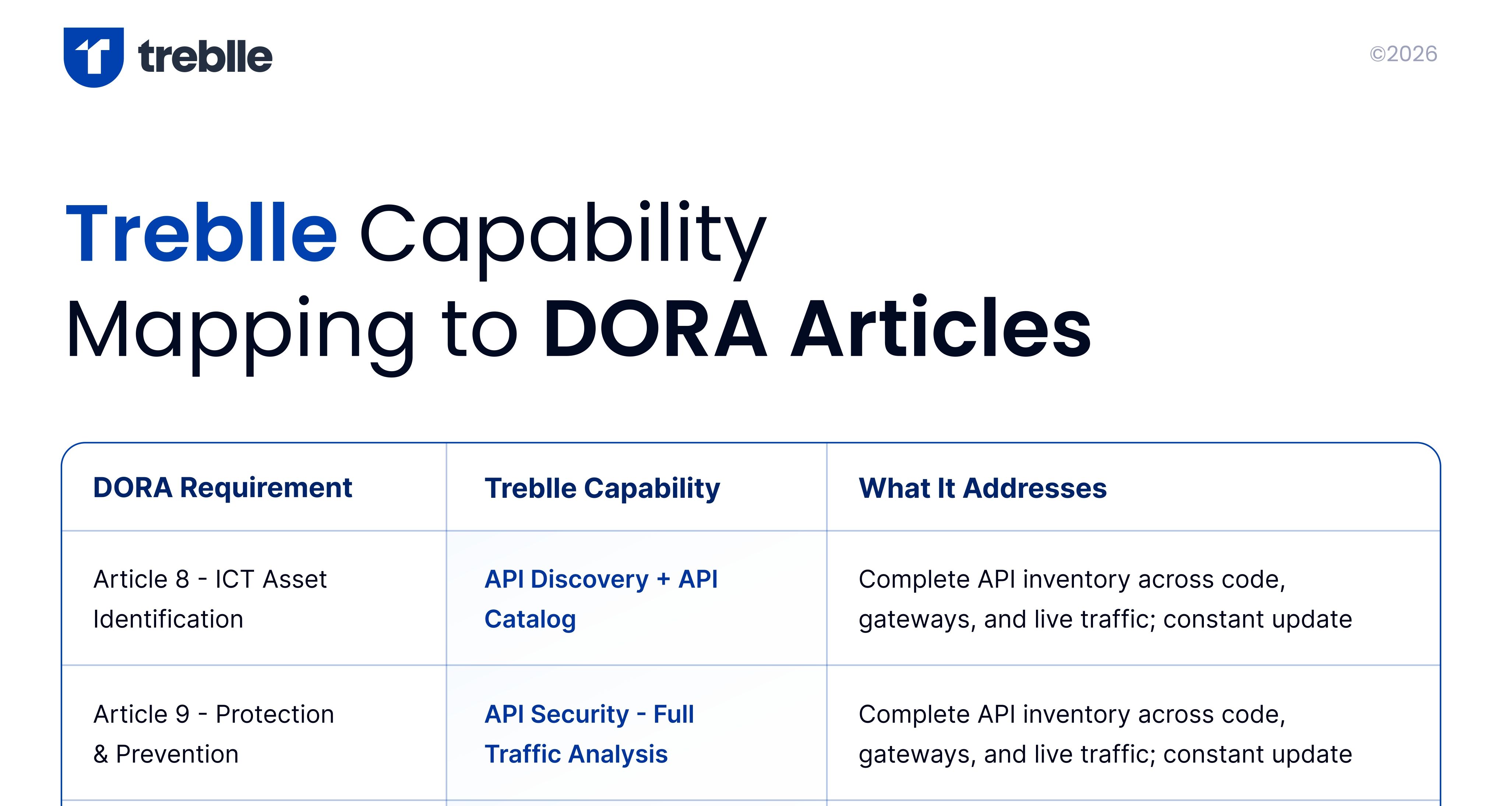
Auto-Generated OpenAPI Docs. A documentation layer that generates OpenAPI specifications from observed request and response traffic. It gives undocumented APIs a documentation link, even when no formal specification previously existed. This makes catalog entries more complete.
Developer Portal. Consumer-facing interface built from catalog data. It surfaces available APIs with documentation, authentication guides, and access provisioning. This makes the catalog accessible to any team that needs to discover and integrate with APIs.
API Governance Checklist
A strategic guide for software architects, platform engineers, and API leadership looking to solve or upgrade their API Governance Programme.
Download EbookWhat is an API catalog?
What is the difference between an API catalog and a developer portal?
How do you keep an API catalog up to date?
Why do organizations need an API catalog?
What is the difference between an API catalog and an API gateway?

All Systems Operational

Gartner: Magic Quadrant, 2025
Gartner AI API Strategy, 2025

Everest Group: Enterprise App Integration Platforms, 2026


