
api-governance
AI Governance for APIs: What Engineering Teams Need to Know

Summarize with


AI governance is no longer just a legal team conversation. The principles, frameworks, and compliance checklists are also required at the API level, especially since APIs have evolved from "plumbing" to the most valuable infrastructure assets a company can have.
AI governance for APIs is about the specific technical work teams need to do when their APIs call language models, expose AI capabilities to consumers, or feed data into AI pipelines.
Organizations need to prepare for the AI API era and that means:
This article covers what each of those looks like for backend and platform engineering teams.
Let's look at the following data:
At that pace, AI governance is no longer something teams can defer to a future architecture review. The APIs are already in production and they're taking over the internet.
Current AI governance frameworks such as the EU AI Act, NIST's AI RMF, and ISO 42001 are ill-equipped to address this. They focus on what the outcomes should look like, but they don't provide the path- the specific technical mechanisms through which API teams deliver those outcomes.
AI governance of your APIs needs four concrete elements:
AI agents are already accessing production APIs. They chain calls across services, submit payloads in unexpected sequences, and operate on inferences that exceed documented API specifications. Governance frameworks designed for human API consumers break down when the consumer is an agent operating at machine speed, with no context about the documentation it hasn't been given.
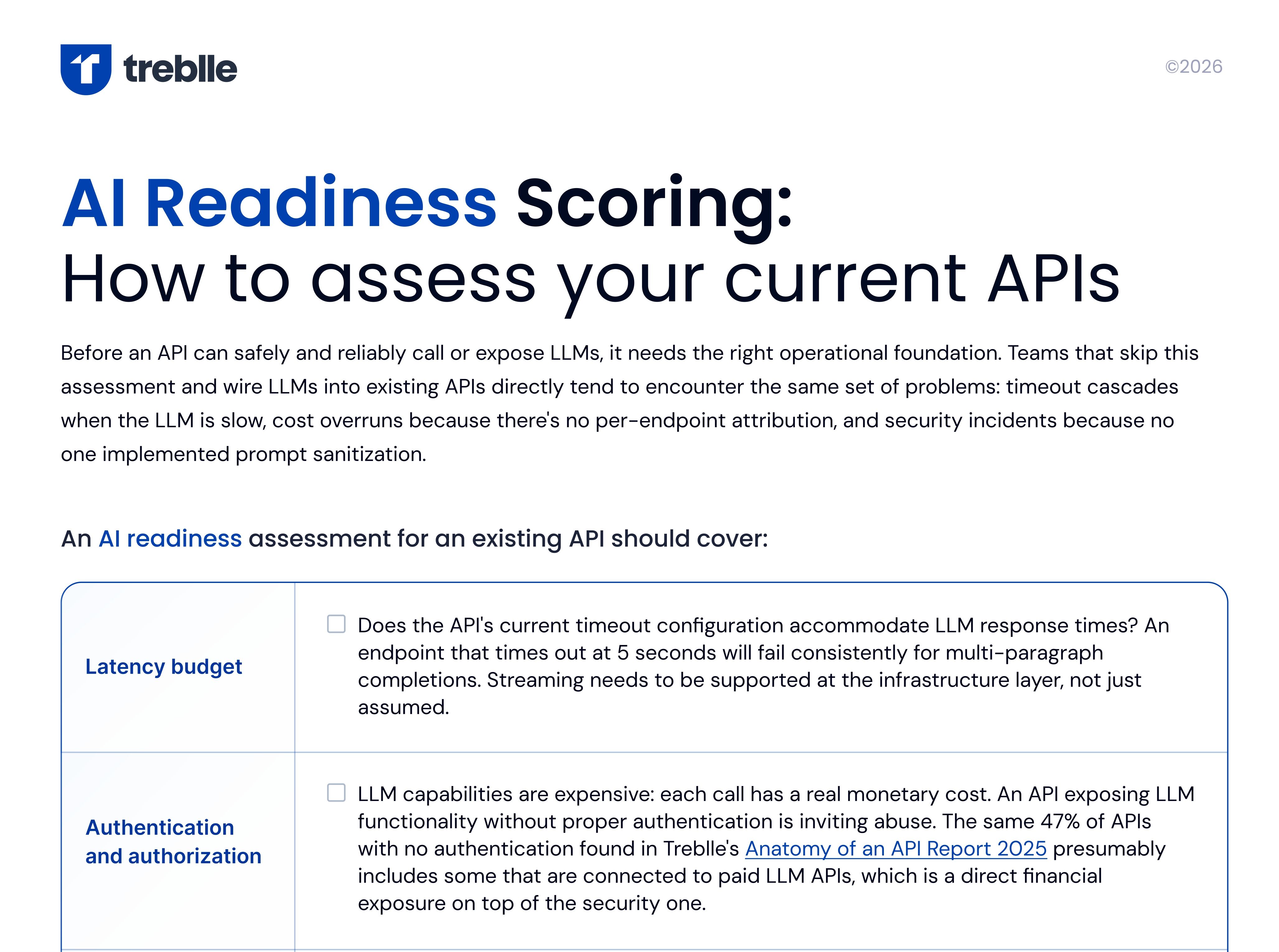
Standard API documentation describes what an endpoint accepts and returns. AI-powered endpoints need additional fields to be governable.
Well-documented AI-powered APIs are not just easier to use, they're the foundation of AI governance. An endpoint whose model, constraints, and failure modes are accurately documented can be audited, versioned, and governed. An undocumented endpoint is ungovernable regardless of what policy framework the organization has adopted.
Treblle's Auto-Generated OpenAPI Docs build specs from live traffic, which catches the common failure mode in which AI-powered endpoints go undocumented because engineers assume they're too variable to document. Alfred, Treblle's AI design assistant, surfaces missing parameter descriptions, incomplete response schemas, and absent operation IDs at design time in VS Code, before those gaps reach production.
Three compliance areas recur for teams operating AI-powered APIs.
When an API call sends user data to a hosted LLM provider, that data leaves the organization's infrastructure and potentially crosses jurisdictional boundaries. GDPR, HIPAA, and sector-specific regulations in financial services and healthcare create requirements about where data can be processed. The compliance question is: Does calling this model endpoint violate the data residency commitments you've made to your users?
The practical answer requires knowing which provider processes the data and where. That needs to be in your documentation and your observability stack. For organizations with strict residency requirements, on-premises model deployment or private cloud inference is the mechanism, not just a preference.
Treblle's on-premises and private cloud deployment option means the observability layer itself stays within the organization's infrastructure, which matters for teams in regulated industries where even telemetry data is subject to data residency constraints.
In regulated environments, the model version that produced a specific output is a compliance artifact. Financial services teams building AI-powered decisioning APIs need to be able to reconstruct which model version produced which recommendation. This is the AI equivalent of code versioning, except that the "code" is a model weight file that the organization often doesn't control directly.
The governance requirement is:
Full logging enables traceability and auditing; retaining user inputs in logs poses a data minimization risk under the GDPR. The resolution is structured masking: log the full payload, but apply sensitive data masking before storage so PII, credentials, and user-identifiable content are stripped while the structural context of the exchange is retained.
AI agents using the Model Context Protocol (MCP) can chain API calls across systems, amplify privilege-escalation vulnerabilities, create indirect data-exposure pathways, and operate outside documented access patterns, all of which require authentication and authorization that hold regardless of which entity is making the call. Compliance frameworks written before agentic AI existed didn't anticipate a non-human caller that can request, infer, and act on data across service boundaries at scale.
Model version tracking is straightforward in principle and systematically neglected in practice. Here is what it requires.
The U.S. Treasury Department recovered $375 million in fraudulent payments in February 2024 using AI-powered detection systems. They couldn't have operated without API infrastructure feeding them real-time financial data. When AI decisions have that level of consequence, the question of which model version produced which decision ceases to be a technical detail and becomes a governance requirement.
AI readiness scoring answers a specific question: Are your APIs structured so that AI agents, LLM tooling, and automated consumers can use them reliably? This is distinct from whether the API works for human-driven integrations.
Treblle's AI Readiness Score evaluates each API endpoint across four criteria:
Each of these affects how reliably an AI agent can construct a valid request and interpret the response.
An endpoint without parameter descriptions forces an AI agent to infer what values to send. An endpoint without response examples gives the agent no baseline for evaluating whether the response it received was valid. An endpoint without an operation ID is harder to reference in tool registries and agent configurations. None of these are breaking changes for a human developer who can read context and make reasonable assumptions. For an agent, each gap is a potential failure mode.
Treblle's broader Governance Score aggregates AI Readiness with Security, Design Quality, and Performance into a 0-100 score for each endpoint and across the API portfolio. The score is continuously updated from both the OpenAPI spec and live traffic data, so it reflects actual runtime behavior, not just what the spec claims.
Improving AI readiness scores follows a predictable pattern:
The sequence matters: parameter descriptions and schema types have the largest impact on agent reliability, so they're worth prioritizing over cosmetic improvements.
For teams working through the foundational API governance framework before tackling AI-specific concerns, the AI Readiness Score gives a concrete second layer to build toward once the security and design dimensions are under control. For teams already running AI-powered APIs in production, it gives a per-endpoint gap list to work from. And for teams looking at the OWASP LLM Top 10 from a security angle, AI readiness and LLM security are the same problem approached from different directions. Undocumented endpoints that agents can't reliably use are also endpoints that security tooling can't reliably monitor.
What is AI governance for APIs?
What is AI governance documentation?
How do I track which AI model version my API is using?
What compliance requirements apply to APIs that call LLMs?
What is an AI readiness score for APIs?

All Systems Operational

Gartner: Magic Quadrant, 2025
Gartner AI API Strategy, 2025

Everest Group: Enterprise App Integration Platforms, 2026


