api-governance
API Governance Tools That Actually Work in Production

Summarize with


The most effective API governance tools in 2026 cover three distinct layers:
Complete API governance can't exist without all three layers, just like atoms can't exist without electrons, protons, and neutrons. Remove one and it all falls apart.
Even though no single category replaces the others, companies often miss out on a runtime observability layer and it's the one most directly connected to the production failures.
Our internal data analysis of 1 billion API requests proves it. Global API scorecard at 58/100, 47% of API requests without any authentication, 42% of traffic runs on HTTP (instead of HTTPS), 17% are zombie endpoints.
To fix governance problems, you need to understand which tools address which problems and this article's gonna do that (in detail).
4 things need to be true for governance to span the entire API lifecycle:
No single tool category addresses all four- that's why you need all of them.
| Category | What it covers | What it doesn't cover |
|---|---|---|
| API Gateways | Authentication enforcement, rate limiting, routing, load balancing | Runtime documentation, schema validation against live traffic, governance scoring, zombie endpoint discovery |
| Design & Spec Tools | Style guide enforcement, OpenAPI validation, mock servers, linting | Production traffic, runtime behavior, undocumented endpoints |
| Observability Platforms | Infrastructure metrics, latency, error rates | API-specific governance scoring, documentation accuracy, schema drift |
| API Intelligence Platforms | Discovery, documentation, security scanning, governance scoring, observability. All from a single integration | Typically narrower in infrastructure policy enforcement compared to dedicated gateways |
Each category is doing real work. The failure mode isn't picking the wrong tool - it's assuming that one category handles what another is better positioned to do.
The starting point of governance for many teams are gateways such as Kong, AWS API Gateway, Azure API Management, and Apigee.
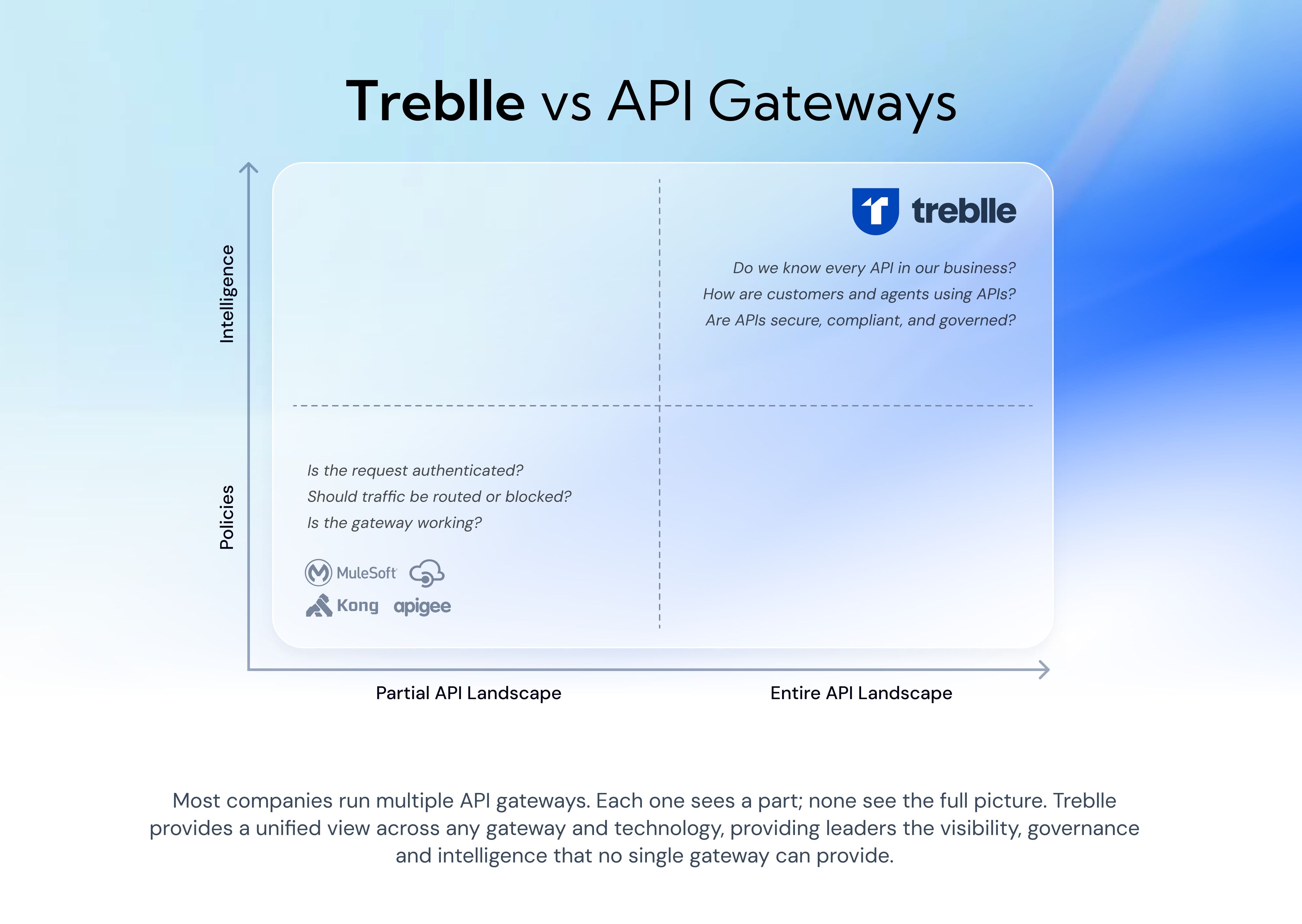
These gateways sit at the traffic entry point and can enforce authentication, rate limits, IP allowlists, and routing policies before a request reaches your backend. That's why they're a good starting point for governance. But they're not enough by themselves.
A gateway enforces the rules you've written for endpoints you know about. But it can't:
API gateways enforce policy at the perimeter. They're a necessary part of the governance infrastructure, but they don't observe what's happening inside your API surface, where most governance failures actually occur.
The rate limiting data is a useful marker here. If gateways were the governance solution, you'd expect near-universal rate limiting adoption among teams that use them. The 15% implementation rate suggests that having a gateway in place doesn't reliably translate to having governance policies applied.
For governance purposes, gateways work best as enforcement layers for policies that have already been defined, verified against production data, and applied intentionally, not as the tool you use to discover what policies you need.
Tools like Stoplight, SwaggerHub, and Postman address governance at the spec level. They bring you halfway there.
With these tools, your team can define style guides, enforce naming conventions, validate OpenAPI specs before deployment, and catch design problems early, when fixing them costs relatively little.
This is genuinely valuable. Getting teams to agree on a standard before code is written is harder than it sounds at scale, and these tools make it tractable. The problem they can't solve is the gap between the spec and the system.
The Anatomy of an API 2025 data illustrates the gap directly: developers consistently report that their APIs use versioning and HTTPS, but runtime measurements contradict those reports at scale. Design-time governance catches what developers put in the spec. It has no reach into what ends up running in production, particularly across the older parts of an API surface that predate the style guide, or endpoints added during an incident response.
For API architects building governance programs, spec tools should be the starting point for new APIs. They shouldn't be the primary measurement of whether governance is working.
Runtime API observability is the third category, the one most relevant to closing the production governance gap. This is where Treblle operates.
The distinction from infrastructure monitoring (Datadog, Dynatrace, New Relic) is worth making explicit. General observability platforms treat APIs as network traffic and report on latency, uptime, and error rates. That's useful for SRE work. It doesn't tell you whether authentication is actually being enforced, whether a response is leaking PII, whether schema drift has opened a gap between the spec and the live endpoint, or whether an endpoint has been silently abandoned.
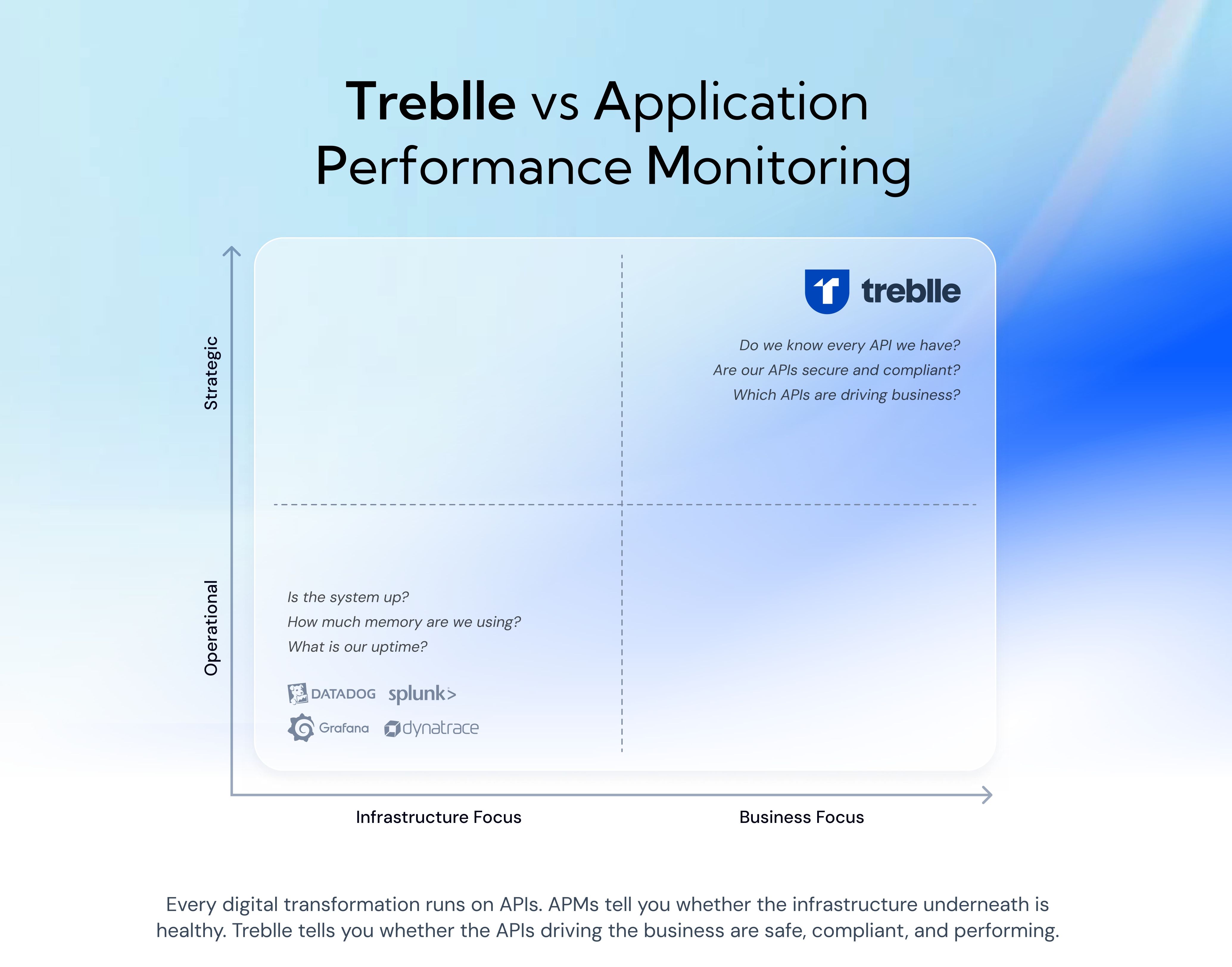
Treblle captures 50+ data points per API request, including authentication context, payload structure, response schema, security signal classification, and timing. Afterward, we apply those to governance scoring in real time. The scoring framework covers four dimensions: AI Readiness, Security, Design, and Performance, producing an A-F grade per API.
The SDK governance scores in the Anatomy of an API 2025 data make the value of this runtime view tangible. NestJS-based APIs score 83 on average; raw NodeJS APIs score 54. That gap isn't theoretical. It reflects actual authentication coverage, encryption enforcement, and schema consistency across production traffic.
Knowing where your APIs sit on that spectrum, and which specific gaps are driving the score down, is the input that makes governance programs actionable rather than aspirational.
Treblle's integrations span 30+ SDKs across languages and frameworks. The instrumentation is added to the application layer, which means it captures internal microservice traffic, including the east-west traffic that runs over HTTP by default and bypasses gateway-level controls.
Documentation in Treblle is generated from live traffic rather than manually maintained. In a codebase where APIs with 100 or more endpoints now represent 38% of the sample (up from 4% in 2024), manually keeping documentation synchronized is operationally unrealistic. Automated spec generation becomes less of a nice-to-have and more of the only way to maintain documentation accuracy at that endpoint count.
The right toolset depends on where you are in building out governance maturity, and which gaps are causing the most pain right now.
If your team is early-stage and building governance from scratch, the most effective investment is in design-time standards (a spec tool like Stoplight) combined with runtime observability from Treblle. The spec tool establishes the pattern for new development; Treblle surfaces what's actually happening across all APIs, including existing ones that predate any governance program.
If you're at a mid-scale organization with an established gateway, the missing piece is almost always runtime observability. The API governance framework guide covers how to connect each tooling layer to a governance policy that teams will actually follow. Gateways tell you what traffic they're handling. They don't tell you whether the APIs behind them are healthy, compliant, or documented. Adding Treblle to a Kong or Apigee deployment closes the visibility gap without displacing existing infrastructure.
At enterprise scale, where the challenge is consistently applying standards across multiple teams, geographies, and API vintages, the combination of all three categories becomes necessary. The sequencing that Treblle's own 2026 roadmap recommendation reflects is worth noting: start with visibility and discovery in Q1, close security gaps in Q2, then shift to governance standardization in Q3. You can't enforce standards across APIs you haven't fully inventoried.
The companies achieving the highest governance scores in 2025 aren't the ones with the most tools; they're the ones with clear visibility into runtime behavior and a process for acting on what they see.
What is the best API governance tool?
What's the difference between an API gateway and an API governance tool?
Do I need separate tools for API documentation and API governance?
How does Treblle score API governance?
Can API governance be implemented without dedicated tooling?

All Systems Operational

Gartner: Magic Quadrant, 2025
Gartner AI API Strategy, 2025

Everest Group: Enterprise App Integration Platforms, 2026