
api-security
API Security Tools: What to Evaluate and How

Summarize with


The API security tools market has five distinct categories that solve different problems. Most procurement decisions go wrong because teams buy a tool from one category thinking it covers another. A WAF doesn't do what a posture management platform does. A gateway with rate limiting isn't a threat scanner. An API-specific DAST tool isn't a runtime observability platform.
Identifying the right category before evaluating vendors saves months of proof-of-concept cycles on tools that were never designed for the problem you're trying to solve. This article maps the five categories, the evaluation criteria that matter within each, and how to structure a proof of concept that produces a decision rather than a report.
The broadest division in the market is between tools that control traffic and tools that analyze it.
Traffic control tools sit in the request path and enforce policy. Gateways apply rate limits, authentication checks, and IP allow/deny lists. WAFs filter known attack signatures before requests reach the application. They're good at enforcing known policies at volume. They're not designed to discover what your API surface looks like, identify behavioral anomalies that fall outside known signatures, or score the security posture of your API portfolio against a set of controls.
Traffic analysis tools observe requests without blocking them (or block only after analyzing them). They're designed to detect anomalies, build behavioral baselines, surface undocumented endpoints, and produce a continuous view of what's actually happening across the API surface. They have less latency impact than in-path tools and can see attack patterns that emerge over time rather than matching against static signatures.
Both categories are useful. Neither covers the other's ground. The mistake is buying a gateway expecting posture visibility, or buying a posture platform expecting low-latency traffic filtering.
A third dimension cuts across both: design-time vs. runtime. Some tools operate on the spec and codebase before deployment: spec linters, SAST tools, and governance rule engines. Others operate on production traffic. Design-time tools catch intent gaps; runtime tools catch drift and live attacks. A complete security toolchain needs both.
1. API gateways with security features
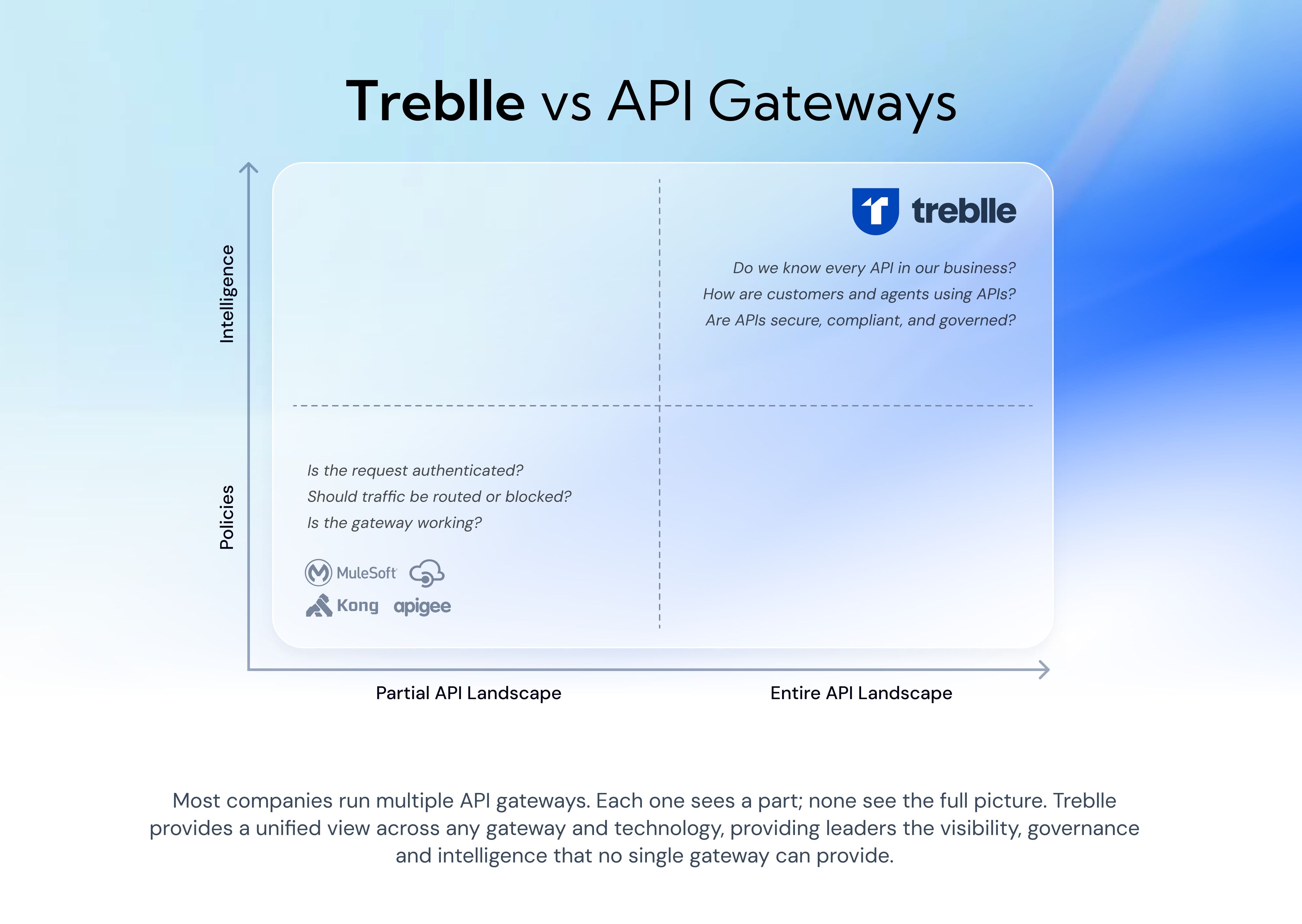
Kong, Apigee, AWS API Gateway, and similar products enforce traffic policy: authentication verification, rate limiting, IP filtering, and request transformation. Their security functions are policy-enforcement functions. They implement controls you define; they don't discover gaps you didn't know existed. Strong choice for teams that need centralized policy enforcement at scale. Not a substitute for threat detection or posture management.
2. Web application firewalls (WAF) with API awareness
Cloudflare, Akamai, Imperva, and others operate at the network edge. They filter requests before they reach the application infrastructure. Traditional WAFs were designed for HTML applications and missed API-specific patterns; modern API-aware WAFs have added rulesets for OWASP API Top 10 patterns. They're effective against known attack signatures and high-volume volumetric attacks. They're less effective against low-and-slow behavioral attacks, BOLA exploitation (which uses valid authenticated requests), and vulnerabilities in the API's own business logic.
3. API-specific DAST and penetration testing tools
StackHawk, 42Crunch, and similar tools run active security tests against a deployed API. They send attack payloads, test authentication boundaries, and check for injection vulnerabilities. They're the automated equivalent of a penetration test, designed to run in CI/CD against staging environments before production deployment. Strong for catching implementation vulnerabilities. Not a runtime monitoring tool; they assess at a single point in time rather than monitoring continuously.
4. API security posture management (ASPM) platforms
Noname Security, Traceable, Salt Security, and Treblle approach security from the runtime observability layer: they continuously monitor production traffic to build behavioral baselines, detect anomalies, surface shadow APIs, and score posture across the portfolio. Gartner formalized the category when it recognized runtime API security as distinct from gateway enforcement and point-in-time testing. Strong for continuous visibility, anomaly detection, and portfolio-level posture scoring. Requires production traffic to be useful; doesn't replace design-time controls.
5. Unified platforms (observability + security + governance)
A smaller category: tools that cover observability, security, documentation, and governance from a single integration point rather than requiring separate products for each function. The integration advantage is significant: a single SDK sees the same traffic for all four purposes. Four separate integrations would each add latency and operational overhead.
Treblle covers all five purposes from one SDK: security scoring, threat detection, governance scoring, observability, and automated documentation generated from the same traffic capture. The evaluation criteria for unified platforms add a question the point-solution categories don't require: does consolidating these capabilities on one platform create unacceptable single-point-of-failure risk? Or does the operational simplicity justify the consolidation?
The build-vs-buy question in API security is often actually a stitch-vs-consolidate question. Do you buy the deepest point solution available for each security function and integrate them, or do you buy a platform that covers multiple functions at the cost of per-function depth?
The point solution argument: the deepest tools in each category are typically more capable in their specific function than any platform that covers all categories. A dedicated DAST tool probably tests more attack scenarios than a posture platform's scanning module. A dedicated WAF has lower latency than a monitoring platform's traffic-filtering add-on.
The platform argument: integration cost is non-trivial. Each point solution requires its own instrumentation, alert routing, log aggregation, and maintenance. For teams with dedicated security engineers to operate a multi-vendor toolchain, point solutions may be the right choice. When the engineering team manages the API security toolchain alongside their other responsibilities, each additional integration is ongoing operational overhead.
A middle path that works for most teams: use the infrastructure layer (gateway, WAF) for high-throughput policy enforcement, and a platform tool for runtime visibility, posture scoring, and governance. Keep the design-time controls (spec linting, static analysis) in CI/CD as a pipeline step that doesn't require a vendor integration at all.
The total cost of an API security tool includes the cost of integrating it, the cost of the alerts it generates that turn out to be false positives, and the cost of the second tool you'll need to cover its blind spots. Evaluating tools on feature lists alone systematically underestimates these costs.
Coverage: what percentage of the API surface does the tool see?
A tool that samples 10% of production traffic gives a probabilistic view of what's happening, not a deterministic one. A low-rate credential stuffing attack that happens to fall in the 90% of traffic not sampled is invisible. Full-fidelity capture (every request, no sampling) is the only approach that covers the entire API surface. Ask vendors specifically about their sampling rate and what happens at high traffic volumes.
Detection method: signature vs. behavioral
Signature-based detection matches requests against known attack patterns. It catches known attacks and misses novel ones. Behavioral detection builds a baseline of normal activity and flags deviations from it. It catches novel attacks and generates more false positives. The best platforms use both: signatures for the known patterns, behavioral baselines for the anomalies that don't match any signature.
Integration depth: how many instrumentation points does deployment require?
A tool that requires a sidecar or agent per service has a deployment cost that scales with service count. A tool that integrates via a single SDK or network tap has a fixed deployment cost regardless of how many services exist. For portfolios with dozens or hundreds of services, integration depth is a major operational consideration.
False positive rate: can the team act on the alerts?
An alert system that fires 200 alerts per day produces alert fatigue that is functionally equivalent to no alerting. Ask vendors for their customers' average signal-to-noise ratio and for examples of the alert types their tool generates. A proof of concept should measure false positive rate as a primary success criterion, not a secondary one.
Deployment model: cloud, on-premises, hybrid
Regulated industries (financial services, healthcare, government) often have data residency requirements that preclude sending production traffic to a vendor's cloud. Confirm the vendor's deployment model and whether on-premises or private cloud options exist before shortlisting.
Treblle's Single SDK Integration covers observability, security scanning, governance scoring, and automated documentation from one integration point. Setting it up takes under two minutes on average. It is available in both cloud and on-premises deployment for organizations with data sovereignty requirements.
Gartner tracks API security within two Magic Quadrant reports: API Management and Application Security Testing. API Management covers gateways, developer portals, and governance; Application Security Testing covers DAST, SAST, and interactive application security testing (IAST) tools that include API testing capability. Gartner's market analysis recognizes API security posture management as a distinct category that requires continuous runtime visibility, separate from gateway enforcement and point-in-time testing.
The practical implication for vendor selection: Gartner's evaluation criteria for API management tools emphasize runtime coverage, policy enforcement, documentation quality, and developer experience. In analyst evaluations, tools that score well on these criteria tend to provide genuine portfolio visibility rather than endpoint-level point assessments.
For current analyst positioning of specific vendors, use the most recent available Gartner Magic Quadrant report as a starting point rather than a final decision. Analyst reports lag the market by 12-18 months. The API security market moves fast enough that the competitive picture shifts meaningfully between publication cycles.
For a deeper look at what posture management covers and how scores are calculated, the API security best practices pillar covers the controls that any tool evaluation should verify are present.
Most PoC processes produce inconclusive results because they measure the wrong things. A PoC that only measures "did the tool detect the attack scenarios in the vendor's demo environment" isn't measuring what will happen in your environment with your traffic patterns and your API surface.
A PoC that produces a decision:
Step 1: Define the specific problem. What is the primary security gap you're trying to close? Continuous posture visibility? Detection of credential stuffing in progress? Shadow API discovery? The answer determines which category of tool to evaluate and which criteria matter most in the PoC.
Step 2: Connect real production traffic, not synthetic traffic. A tool evaluated on synthetic traffic shows you what the tool can do in theory. A tool evaluated on your production traffic shows you what it will do in your environment. The difference is typically significant: production traffic surfaces edge cases, unusual consumer behavior, and existing anomalies that synthetic traffic doesn't include.
Step 3: Measure false positive rate explicitly. Run the tool for two weeks before you evaluate its detection capability. Classify every alert as true positive, false positive, or inconclusive. A tool with a 10% true positive rate means your team spends 90% of their alert response time on noise.
Step 4: Measure integration and operational overhead. How long did deploying the tool take? How many services required changes? How much ongoing maintenance does the tool require? This is often the deciding factor for engineering-operated tools. It's rarely part of the vendor's PoC narrative.
Step 5: Evaluate the investigation experience. When a true positive alert fires, how quickly can you trace the full session (every request, consumer identity, payload, response) to determine what happened? The alert tells you something is wrong. The investigation tooling tells you what it was and what to do about it.
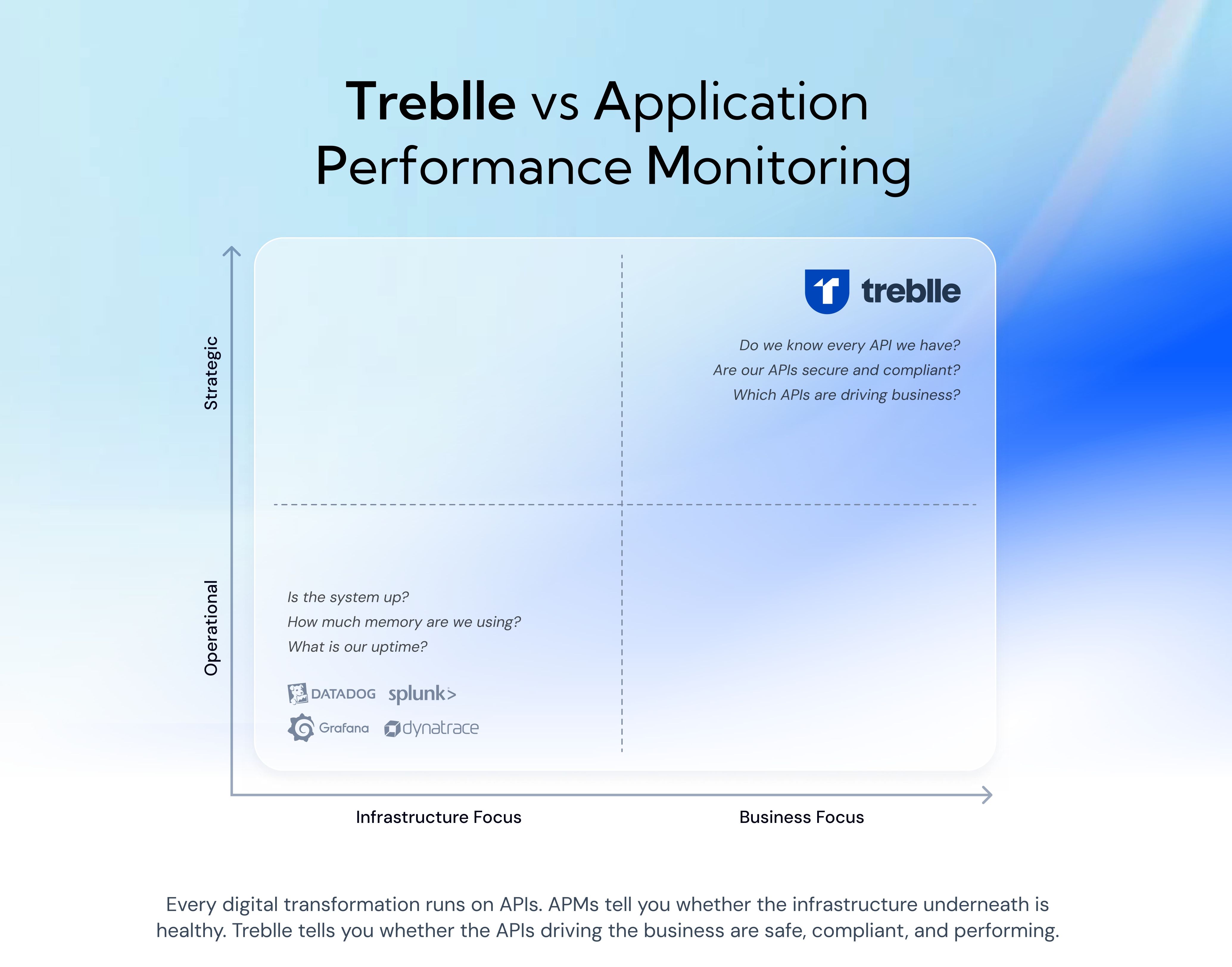
A PoC built around these five steps produces a decision instead of a report. Treblle designed the Security Score, Automated Threat Scanning, and Authentication Coverage Tracking to be evaluable against real production traffic from day one. The Security Score shows you an immediate baseline posture view. Authentication Coverage Tracking compares what the spec declares as required against what the implementation actually enforces, which surfaces the authentication gaps present in most portfolios before anyone starts remediation work.
The API observability guide and the API governance framework cover how monitoring and governance scoring work together across the portfolio, and explain the observability infrastructure that underpins security monitoring.
To run a proof of concept against your current API portfolio and see a baseline Security Score, Treblle connects in under two minutes from a single SDK.
Security Score. Per-endpoint security grade that Treblle evaluates continuously from production traffic across authentication enforcement, HTTPS/TLS status, insecure direct object reference (IDOR) exposure, and security header presence. This grade establishes the portfolio-level posture baseline. Teams re-check the same score after a security investment to see whether the number actually moved.
Automated Threat Scanning. Evaluates every request in real time against 20+ threat categories including SQL injection, XSS, credential stuffing, and path traversal. No sampling: full-fidelity capture at production scale. This runtime threat signal feeds directly into the posture score.
Authentication Coverage Tracking. Identifies which endpoints process unauthenticated production traffic in practice. Surfaces the gap between what the spec declares as required and what the implementation actually enforces. One of the most common first findings in any API security posture assessment.
Custom Governance Rules (Spectral). Design-time enforcement layer: custom linting rules that run in CI/CD on every spec change. These rules implement the shift-left control that complements runtime monitoring. Authentication scheme requirements, input constraint checks, and response schema completeness rules fire before deployment.
Single SDK Integration. One SDK covers security scanning, observability, governance scoring, documentation, and analytics. Reduces the integration surface to a single point, eliminates the operational overhead of a multi-vendor toolchain, and ensures all security functions see the same full-fidelity traffic.
API Governance Checklist
A strategic guide for software architects, platform engineers, and API leadership looking to solve or upgrade their API Governance Programme.
Download Ebook
What do API security tools do?
What is the difference between a WAF and an API security platform?
How do you evaluate API security tools?
What does Gartner say about API security?
How long does an API security tool PoC take?

All Systems Operational

Gartner: Magic Quadrant, 2025
Gartner AI API Strategy, 2025

Everest Group: Enterprise App Integration Platforms, 2026


