
api-security
Shift Left Security: Applying It to API Development

Summarize with


High-threat API traffic nearly tripled in a single year. This represents millions of sophisticated SQL injection, XSS, and remote code execution probes hitting production APIs daily. The common response is to invest in runtime detection: firewalls, threat scanning, anomaly monitoring. Those controls matter. But they operate after the vulnerability exists, after the code is deployed, after the attack surface is live.
Shift-left security is the complement. It moves security checks earlier in the development cycle, so vulnerabilities are caught when they're cheapest to fix, during spec review and design. For API teams specifically, this means embedding security validation at three points where APIs are shaped before they reach production: the spec, the CI/CD pipeline, and the code review.
"Shift left" refers to moving an activity earlier on the development timeline, which is typically drawn left-to-right from design through deployment. Security at the right end (production monitoring, penetration testing) finds problems that are expensive to fix. Security at the left end (design validation, spec review) finds problems when a conversation or a linting rule is the cost of correction rather than a production rollback and potential incident.
For API teams the left end has a specific artifact: the OpenAPI specification. The spec expresses security requirements before implementation begins: which endpoints require authentication, which accept which input types, which return which data. A spec that correctly declares all security requirements creates a verifiable contract that implementation and testing can be held against. A spec that omits authentication requirements, leaves input schemas underspecified, or fails to declare security schemes doesn't just represent a documentation gap. It means there's no design-time checkpoint to catch those omissions.
Three questions define the shift-left posture for an API:
Each question corresponds to a stage where security can be checked. Missing any one of them creates a blind spot that the others can't fully compensate for.
The shift-left argument is sometimes misread as replacing runtime security. It isn't. Design-time and runtime security catch different things.
Design-time security catches intent gaps: places where the spec or implementation plan doesn't include a required control. Common examples include:
These are problems of specification and intent: the developer hasn't defined what the security requirement is, so there's nothing to implement incorrectly. Design-time validation catches them before implementation.
Runtime security catches drift: the gap between what was specified and what's actually happening in production. Common examples include:
These are problems of implementation and production state that only become visible once the code is running and traffic is flowing.
NestJS APIs score 83/100 on Treblle's governance scorecard; Django APIs score 49. That 34-point gap traces directly to framework-level defaults on authentication and security headers. Framework defaults are a design-time decision made once at project kickoff that ripples through every endpoint for the lifetime of the API. Shift-left catches and corrects that decision.
Design-time security can't replace runtime monitoring, and runtime monitoring can't replace design-time security. Specs that don't declare authentication requirements will produce implementations that don't enforce them. Spec validation alone won't catch implementations that enforce authentication on the wrong endpoints. The two layers are complements, not substitutes.
CI/CD is the natural enforcement point for shift-left security because it runs on every change, is already part of the development workflow, and can fail a build before broken code reaches production. For APIs, three types of checks belong in the pipeline:
Spec linting validates the OpenAPI spec against a defined ruleset before the spec is merged or deployed. Rules can be custom-defined or drawn from standard rulesets like OWASP's API Security Top 10 mapped to spec-level checks. Custom rules might require every endpoint to declare an authentication scheme, require every response to define error codes, or require every input field to specify a maximum length. A spec that fails linting doesn't merge. The developer gets a specific error on the offending line and fixes it before the pull request proceeds.
Treblle's Custom Governance Rules encode spec requirements as Spectral-based linting rules that run automatically in CI/CD. A rule can require every endpoint to declare a security scheme, or flag any endpoint that accepts a string field without a maxLength constraint. Each such rule fires on every spec change. It catches the omission at the point where it costs one developer conversation to fix, not a production rollback.
The 2025 API Security Checklist
Stay ahead of emerging threats with our 2025 API Security Checklist.
Download Ebook
Contract testing verifies that the implementation matches the spec. If the spec says an endpoint returns a 401 for unauthenticated requests, contract testing confirms the implementation actually returns 401, not 200 with a truncated response or 500 from an unhandled null. Contract tests run against a deployed instance (staging, preview environment) and fail the pipeline if the behavior diverges from the contract.
Security scanning runs static analysis against the implementation to identify patterns associated with common vulnerabilities: hardcoded credentials in source files, SQL query construction via string concatenation, missing input sanitization before database operations. This is language-specific and complementary to spec linting: the spec linting checks the contract, and static analysis checks whether the implementation introduces vulnerabilities the contract doesn't address.
Spec validation is the earliest possible shift-left checkpoint. It runs before implementation begins, when the spec is the only artifact that exists. Done well, it produces a spec that is complete enough to implement against: every endpoint declares authentication, every input has a type and constraints, every response has a schema.
The practical challenge is that spec review is often informal. A developer writes a spec, someone reviews the pull request, and the review focuses on the design decisions (naming, structure, resource model) rather than the security declarations (authentication schemes, input constraints, error responses). Security requirements get overlooked not because reviewers don't care but because there's no checklist enforcing that they were checked.
Automated spec validation solves this with a checklist that runs on every spec change rather than relying on a reviewer to remember it. The checks that belong at this layer:
Alfred, Treblle's AI design assistant for VS Code, evaluates spec quality against governance rules in real time, as the spec is being written. It flags missing authentication declarations, parameter descriptions that don't provide enough context for consumers to use the API correctly, and schema quality issues before the spec is even committed. The feedback loop is immediate rather than catching issues at code review or later.
Penetration testing is a runtime security activity: it runs against a deployed instance rather than against a spec or code. It sits at the right end of the development timeline by definition. But where it fits in a shift-left strategy matters: run it at the wrong point and the findings are too expensive to act on; run it at the right point and it complements the design-time checks.
Penetration testing belongs at two points in the API development lifecycle:
Pre-production, against staging. This runs before a new API or major feature goes live. Findings at this stage are still in the "cheap to fix" zone: the code exists, the API is deployed, but production consumers don't depend on it yet. A penetration test here catches implementation vulnerabilities that spec validation and static analysis missed: business logic flaws, authorization checks that pass unit tests but fail adversarial testing, rate limiting that's configured but bypassable.
Post-production, on a scheduled basis. This doesn't replace continuous monitoring. It verifies that the overall posture holds against adversarial testing methodology. Annual penetration testing as a compliance exercise is a minimum; quarterly is better for APIs handling sensitive data.
What to prioritize in an API penetration test:
Shift-left security for an API program is operational, not conceptual. The controls that implement it:
Treblle's Security Score then provides the continuous feedback loop that confirms whether the design-time controls are working in production. It's a security grade per endpoint, updated from live traffic, that tells you whether the controls specified in the design phase are actually enforced in the implementation.
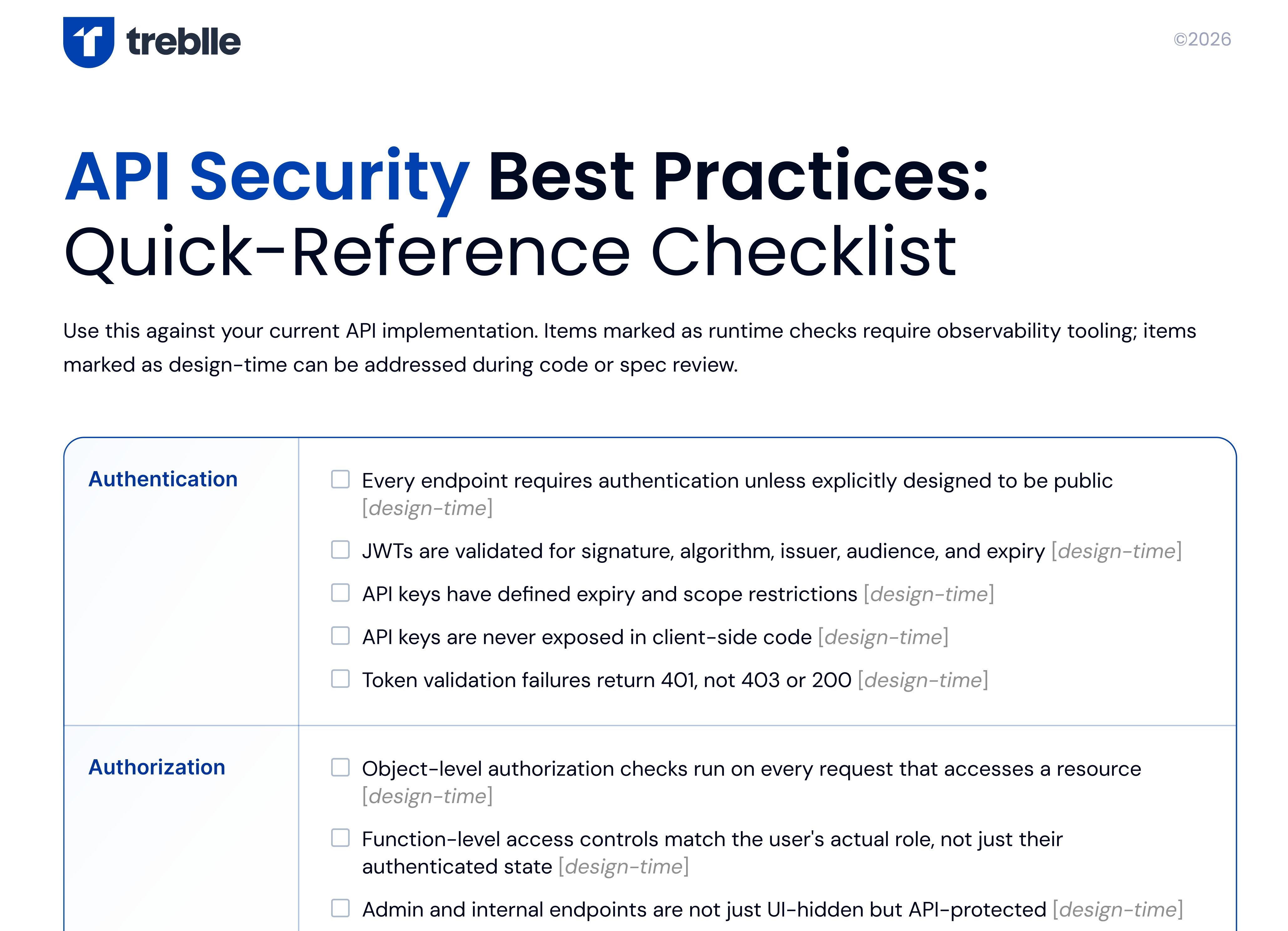
To connect the shift-left controls above to the specific checklist items they cover, the API security checklist maps each control area to the spec and implementation declarations that need to be present. The API governance framework covers how governance scoring tracks these controls at portfolio scale.
Alfred (AI Design Assistant). Real-time spec quality feedback in VS Code: flags missing authentication declarations, underspecified parameters, schema gaps, and design quality issues as the spec is being written, before commit, before review, before implementation.
Custom Governance Rules (Spectral). Spectral-based lint rules that encode shift-left requirements and run automatically in CI/CD on every spec change. Authentication scheme requirements, input constraint checks, and response schema completeness rules fire before deployment rather than after a production incident.
Security Score. Per-endpoint security grade updated continuously from live traffic. Closes the loop on shift-left by confirming whether what was specified in the design phase is actually enforced in production. It surfaces the drift that design-time checks can't see.
Automated Threat Scanning. A runtime scan that evaluates every request against 20+ threat categories in real time. Where shift-left catches the intent gaps, Automated Threat Scanning catches the implementation gaps and the production attacks that exploit them.
To start embedding spec validation and governance rules into your current API workflow, Treblle's Alfred VS Code extension and governance scoring are available from the first connected API.
The 2025 API Security Checklist
Stay ahead of emerging threats with our 2025 API Security Checklist.
Download EbookWhat is shift-left security testing?
What is the difference between shift-left security and DevSecOps?
How do you implement shift-left security for APIs?
When should API penetration testing run relative to shift-left controls?

All Systems Operational

Gartner: Magic Quadrant, 2025
Gartner AI API Strategy, 2025

Everest Group: Enterprise App Integration Platforms, 2026


