
api-security
Account Takeover Prevention via APIs: What to Monitor

Summarize with


47% of APIs process requests with no authentication. Only 6% of all recorded API errors are 401 Unauthorized. This means systems aren't checking for unauthenticated requests in the first place, so they aren't rejecting them. In that environment, account takeover isn't a question of whether attackers can find a way in. It's a question of whether your monitoring is sensitive enough to see them while the attack is still in progress.
Account takeover (ATO) prevention at the API layer is different from ATO prevention at the application layer. Browser-based controls operate on assumptions that APIs don't share:
These controls include CAPTCHA, device fingerprinting in session cookies, and login page rate limiting. API attacks bypass all of those assumptions deliberately. The attack surface is the authentication endpoint itself, accessed directly by an automated client that can cycle IPs, rotate credentials, and vary its request patterns faster than any human reviewer can track.
This article covers how ATO attacks target APIs, which signals indicate an active attempt, and how to build the monitoring and controls that catch attacks in progress.
API-targeted ATO attacks have a specific shape. They're largely automated, they target authentication endpoints and object-level authorization boundaries, and they exploit the same gaps that make APIs fast and developer-friendly. These gaps include predictable URL structures, consistent response formats, and the absence of friction controls that would slow down legitimate users.
Ther are four primary attack patterns:

The 2025 API Security Checklist
Stay ahead of emerging threats with our 2025 API Security Checklist.
Download Ebook
The terms are used interchangeably but describe different attack types with different detection profiles.
Brute force attacks enumerate possible passwords against a single account. They're detectable because they generate high volumes of failed authentication attempts for the same username. When a login endpoint allows 1,000 attempts per minute per account without triggering a lockout, it's vulnerable to brute force. Brute force is the oldest and most detectable form of authentication attack.
Credential stuffing uses known valid username-password pairs from other breaches rather than guessing passwords. The attacker isn't trying to find a password. They're testing whether a user reused a password from a breached service. The detection profile is different: requests come from many different IPs, each making a small number of attempts, with a realistic username and a password that's known to have been valid somewhere. Rate limiting on a single IP or account catches brute force; it doesn't catch credential stuffing because the attack is distributed.
Account takeover is the outcome: the attacker has authenticated as a victim. Credential stuffing is the most common mechanism, but ATO can also occur through session hijacking, BOLA exploitation, or social engineering.
ATO detection focuses on post-authentication signals: does this authenticated session behave like the legitimate account owner? A successful authentication from a new country is an ATO signal when immediately followed by a large data export, even though the authentication itself succeeded.
The active attack type determines the appropriate response. Rate limiting stops brute force. Distributed rate limiting and behavioral monitoring stop credential stuffing. Post-authentication anomaly detection catches ATO after the authentication boundary has been crossed.
The signals that indicate an ATO attack in progress cluster into three phases: pre-authentication, authentication, and post-authentication.
Pre-authentication signals:
Authentication-phase signals:
Post-authentication signals:
The most dangerous ATO signals are post-authentication. Pre-authentication signals indicate an attack attempt. Post-authentication signals indicate a successful compromise. The window between a credential stuffing success and a harmful action is often minutes so detection has to be fast enough to interrupt the session.
Rate limiting is the primary technical control against brute force and a partial control against credential stuffing. Only 15% of APIs implemented it in 2025, despite being an OWASP Top 10 control and one of the cheapest security controls to deploy.
Effective rate limiting for ATO prevention requires:
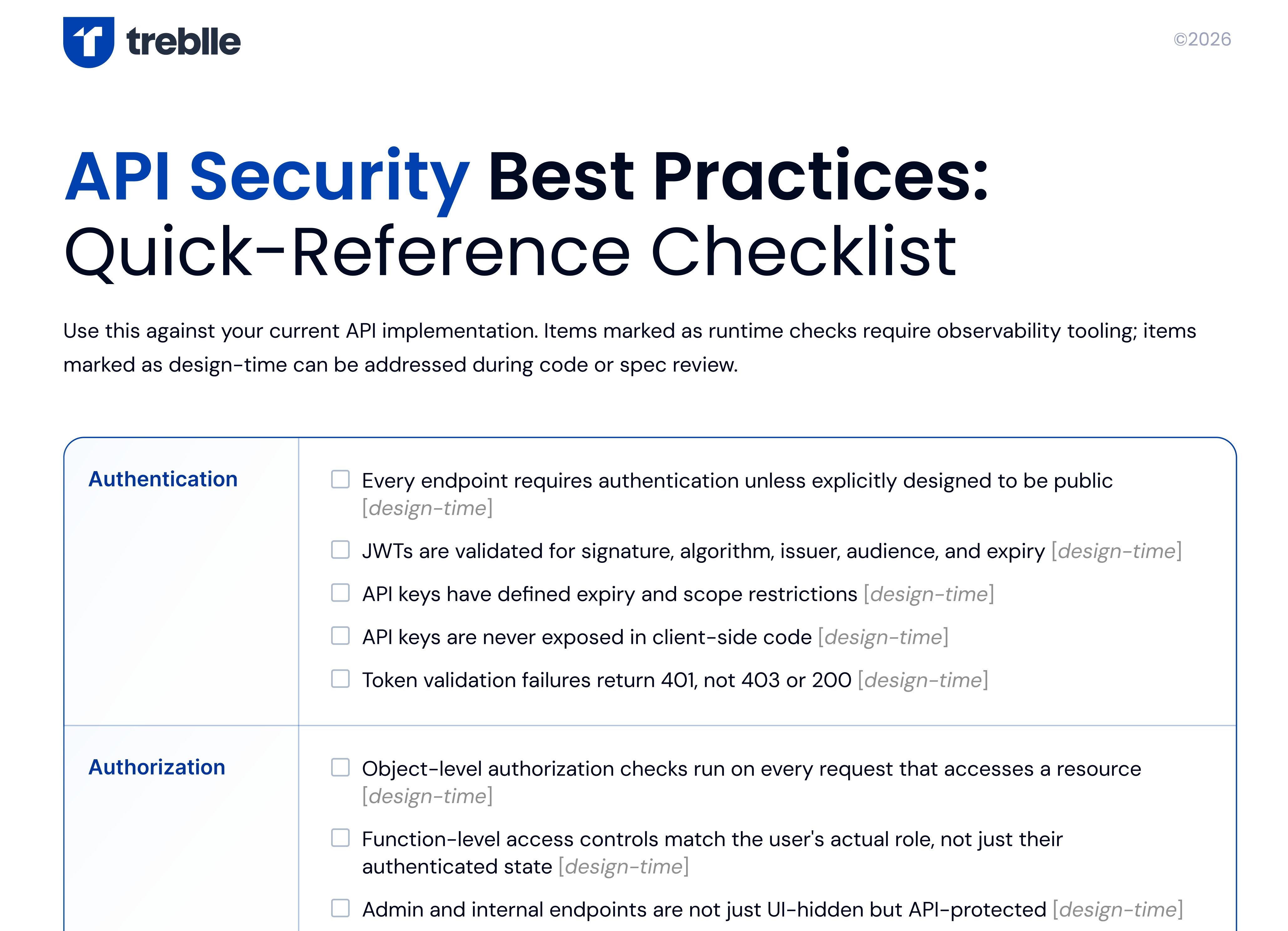
For the full controls list, the API security checklist covers rate limiting alongside authentication, transport security, and input validation in detail.
Rate limiting catches volume-based attacks. Behavioral monitoring catches the attacks that operate below volume thresholds: credential stuffing at low rates, and post-authentication compromise.
The foundation is a behavioral baseline per consumer: what does this API consumer normally do? How many requests per session? Which endpoints? From which geographic region? At what times? A baseline built from historical data makes anomalies detectable: not by comparing to a generic threshold, but by comparing to the specific consumer's established pattern.
Treblle's Consumer Analytics tracks per-consumer data across call volume, geographic origin, client type, error rate, and request patterns. This data builds the baseline that makes behavioral anomalies visible. Consider a consumer who normally makes 50 requests per session from Germany. A sudden spike to 2,000 requests from a Brazilian IP is an anomaly worth investigating, regardless of whether authentication succeeded.
Consumer fingerprinting adds a layer below authentication: even if a valid token is presented, does the client match the profile of the account's legitimate access pattern? When a token that's always presented from a mobile SDK client is suddenly used from a server-side HTTP client, it suggests the token has been extracted and is being used by an automated tool.
The combination of rate limiting and behavioral monitoring covers the full ATO attack surface. Rate limiting stops volume attacks; behavioral monitoring catches low-rate and post-authentication attacks. Neither is sufficient alone. Rate limiting that's sophisticated enough to catch distributed credential stuffing will also block some legitimate users. Behavioral monitoring without rate limiting is too slow to stop a fast-moving brute force attempt.
The choice between alerting and blocking has different implications depending on the attack phase and confidence level.
Block immediately:
Alert and investigate:
Log and baseline:
Treblle's Real-Time Request Explorer provides the investigation layer: when an alert fires on a suspicious session, every request from that session is available for inspection: full payload, endpoint sequence, response codes. This lets teams triage quickly whether the behavior represents an attack or a legitimate edge case.
Treblle's Automated Threat Scanning evaluates every request against 20+ threat categories in real time. This includes credential stuffing patterns, enumeration probes, and injection attempts embedded in authentication payloads. It provides a continuous threat signal that complements the behavioral anomaly detection layer (Source: Treblle, Anatomy of an API 2025).
Most ATO attacks at the API layer stem from two authorization vulnerabilities: BOLA and Broken Authentication. The OWASP API Security Top 10 covers both in broader API security context. The API security best practices pillar covers the full prevention framework.
Consumer Analytics. Per-consumer behavioral baseline built from call volume, geographic origin, client type, and error rates. Surfaces behavioral anomalies: geographic shifts, volume spikes, unusual endpoint access patterns. These indicate post-authentication compromise even when the session token is valid.
Automated Threat Scanning. Real-time evaluation of every request against 20+ threat categories, including credential stuffing patterns, enumeration probes, and injection attempts in authentication flows. This provides the automated detection layer that surfaces ATO attempts before they succeed at scale.
Real-Time Request Explorer. Full request capture for every session: endpoint sequence, payloads, response codes, consumer identity. When a behavioral alert fires, the request history is immediately available for triage. This compresses the investigation timeline from hours to minutes.
Authentication Coverage Tracking. Identifies which endpoints process unauthenticated requests in production. ATO attacks target the authentication boundary; knowing which endpoints have no authentication enforced tells you where the boundary doesn't exist yet.
What is account takeover prevention?
What is the difference between credential stuffing and brute force?
How do APIs make account takeover easier for attackers?
What signals indicate a credential stuffing attack?
How does behavioral monitoring help with ATO detection?

All Systems Operational

Gartner: Magic Quadrant, 2025
Gartner AI API Strategy, 2025

Everest Group: Enterprise App Integration Platforms, 2026


